▶ English · Tiếng Việt · 3:10 · Script: demo-video-series.en.md
In one sentence: a submitted document in Astra is final; you correct it by cancelling (which writes reversals, never edits) and amending (which creates one new linked draft), and every step runs in a single database transaction together with the documents and ledger entries it causes.
Read this if: you write hooks and need to know exactly what runs inside the submit/cancel transaction (developer angle) / you are deciding how an ERP-style platform should guarantee audit trails and consistency between orders, waybills and accounting (tech-lead angle).
The problem
Astra Express takes a customer order, hands it to operations as a waybill, and bills the shipping fee to the customer's receivable account. Three records, owned by three teams (OMS, OPS, BMS), describe one business fact. In most hand-built systems these records drift apart:
- The order is "confirmed" but the waybill insert failed, so the parcel is never picked up.
- Someone fixes a typo in a confirmed order with an
UPDATE, and the invoice that was already sent no longer matches the database. - Accounting "deletes" a wrong journal line, and the auditor cannot reconstruct what the books said last month.
Frappe/ERPNext solved the business side of this years ago with docstatus (0 Draft, 1 Submitted,
2 Cancelled) and the Amend button, and ERPNext posts reversing GL entries on cancel. Astra keeps that
model, because accountants and operators already understand it, and adds two things a platform kernel
can enforce: the lifecycle step and everything its hooks write share one transaction, and the ledger
table refuses UPDATE and DELETE at the database level.
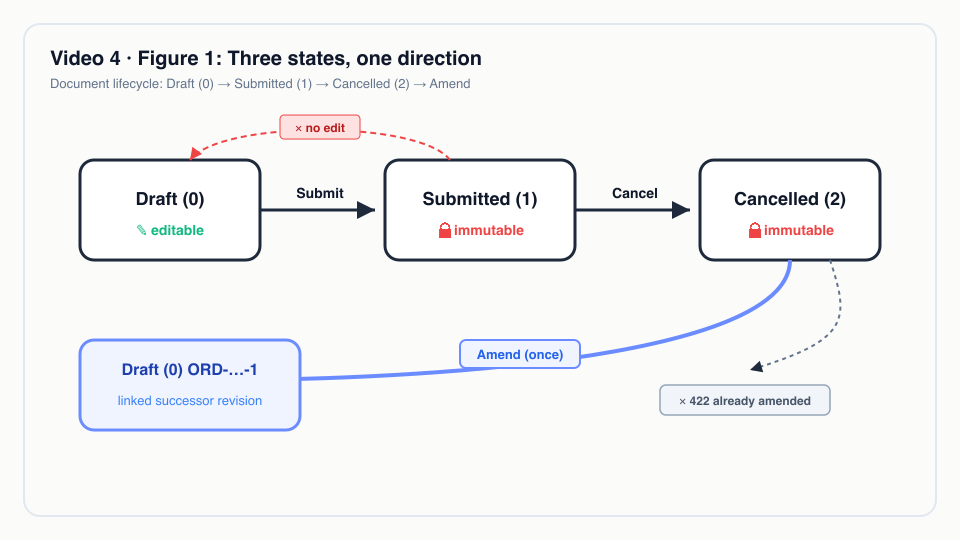 The three document states and legal transitions. Amend creates a new draft; submitted documents can only be cancelled, never edited.
What the video shows
The video follows one new order for customer C001 in tenant saigon-express, signed in as mai (admin).
| Scene | What you see | What it proves |
|---|---|---|
| States | Draft → Submitted → Cancelled → Amend, one direction | Only three docstatus values; Amend creates a new document instead of moving backwards. |
| Create | Draft ORD-20261021-00011, fee 58,000 ₫ set by the pricing hook on save, waybill empty |
Side effects wait for Submit; a draft is still freely editable. |
| Submit | Status becomes Submitted, waybill WB-2610-000008 appears, "Ledger entries" shows Debit 131 / Credit 511, 58,000 |
The waybill and the journal entry are written in the same transaction as the status change. |
| One transaction | Code card from DocumentStore.submit |
Hooks join the open connection; a failure anywhere rolls everything back. |
| Locked | Form fields locked; a PUT through the API returns 422 submitted documents are immutable; cancel and amend instead |
Immutability is enforced in the kernel, not only hidden in the UI. |
| Cancel | Waybill becomes Cancelled; ledger gains two reversing lines (Debit 511 / Credit 131); the two original lines are unchanged | Cancel never edits or deletes; it appends a mirror entry. |
| Amend | ORD-20261021-00011-1, Draft, "amends ORD-20261021-00011", waybill empty |
A new revision, linked to the old one; the cancelled version stays in history. |
| Re-amend | Amend on the cancelled original again → 422 ORD-20261021-00011 was already amended as ORD-20261021-00011-1 |
Each cancelled document gets exactly one amendment; further changes go on -1. |
| API | make demo-express SCENES=4: create (201), submit (200), rejected edit (422), cancel (200), waybill Cancelled, amend (201) |
Desk uses the same REST endpoints; there is no private UI path. |
Document numbers in the Desk scenes (ORD-…-00011, WB-2610-000008) differ from those in the API log
(ORD-20261021-00008, WB-2610-000006) because they were recorded in separate runs.
How it works
The three transitions live in the kernel
All lifecycle rules sit in one class, DocumentStore, so every app gets the same behaviour. A DocType opts
in with submittable: true.
astra-apps/express/src/main/resources/META-INF/astra/doctypes/customer-order.doctype.yaml
name: CustomerOrder
module: oms
kind: transaction
submittable: true                 # Draft (0) -> Submitted (1) -> Cancelled (2) -> Amend
transaction: global               # submit/cancel span BMS credit (Seata AT) and pickup capacity (Seata TCC)
naming: { series: "ORD-.YYYYMMDD.-.#####" }
# …
  - { name: waybill,          type: Link,     options: Waybill, read-only: true, in-list: true }   # created on submit
Submit and cancel are short and symmetrical. Note the order of operations: the hooks run before the
kernel writes the new docstatus, on the same connection, and the final write uses an optimistic version
check.
astra-doctype/src/main/java/io/astra/doctype/store/DocumentStore.java
public Optional<Document> submit(String doctype, String name) {
    DocTypeDefinition def = requireSubmittable(doctype);
    return global(def, "submit " + doctype + " " + name, () -> inTenantTx(conn -> {
        Optional<Document> existing = get(doctype, name);
        if (existing.isEmpty()) return Optional.empty();
        Document doc = existing.get();
        requireDraft(doc);
        requireCaller(doc, Action.SUBMIT);
        hooks.onSubmit(doc);
        DocumentValidator.applyDefaultsAndValidate(def, doc);
        validateLinks(conn, def, doc);
        return Optional.of(write(conn, doc, 1));
    }));
}

public Optional<Document> cancel(String doctype, String name) {
    DocTypeDefinition def = requireSubmittable(doctype);
    return global(def, "cancel " + doctype + " " + name, () -> inTenantTx(conn -> {
        // …
        if (doc.docstatus() != 1) throw new DocValidationException("only submitted documents can be cancelled");
        requireCaller(doc, Action.CANCEL);
        hooks.onCancel(doc);
        return Optional.of(write(conn, doc, 2));
    }));
}
Immutability is one guard, shared by update and submit:
astra-doctype/src/main/java/io/astra/doctype/store/DocumentStore.java
private static void requireDraft(Document doc) {
    if (doc.docstatus() == 1) throw new DocValidationException("submitted documents are immutable; cancel and amend instead");
    if (doc.docstatus() == 2) throw new DocValidationException("cancelled documents are immutable; amend instead");
}
Why in the kernel: if immutability were a UI convention, any script, integration or AI agent calling the API could still edit a submitted order. Putting the check in the only write path means Desk, REST, MCP tools and hooks all hit the same rule.
"One transaction" is a ScopedValue, not a convention
The claim "all in one transaction" rests on TenantTransactions. The first call opens a connection, binds
the tenant for row-level security and stores the connection in a Java ScopedValue. Any nested call (a
hook inserting a waybill, the ledger posting an entry) finds the bound connection and joins it.
astra-doctype/src/main/java/io/astra/doctype/store/TenantTransactions.java
public <T> T inTenantTx(SqlWork<T> work) {
    if (TX.isBound()) {
        try {
            return work.run(TX.get());
        } // …
    }
    String tenant = TenantContext.require();
    try (Connection conn = dataSource.getConnection()) {
        conn.setAutoCommit(false);
        try {
            // … SELECT set_config('astra.tenant', ?, true)
            T result = ScopedValue.where(TX, conn).call(() -> work.run(conn));
            conn.commit();
            return result;
        } catch (Exception e) {
            conn.rollback();
            // …
Why a ScopedValue rather than a thread-local or passing Connection through the SPI: hooks only see
DocumentService and GeneralLedger (from astra-spi), so app code never handles connections, cannot leak
one, and cannot accidentally open a second transaction. ScopedValue is bounded by the call, works with
virtual threads, and disappears when the outer operation returns.
The hooks that ride along
CustomerOrder has several hooks; three matter for this video. The kernel's HookRegistry groups every
installed DocLifecycleHook by DocType and calls each in turn.
astra-apps/express/src/main/java/io/astra/apps/express/OrderWaybillHook.java
@Override
public void onSubmit(Document order) {
    Document waybill = docs.insert("Waybill", Map.of(
            "order", order.name(),
            "receiver_name", order.getString("receiver_name")), order.owner());
    order.set("waybill", waybill.name());
}

@Override
public void onCancel(Document order) {
    String name = order.getString("waybill");
    if (name == null) return;
    Document waybill = docs.get("Waybill", name).orElseThrow(() -> new DocValidationException("waybill " + name + " not found"));
    String status = waybill.getString("ops_status");
    if (!CANCELLABLE.contains(status)) {
        throw new DocValidationException("cannot cancel " + order.name() + ": waybill " + name + " is already '" + status + "'");
    }
    docs.update("Waybill", name, Map.of("ops_status", "Cancelled"));
}
astra-apps/express/src/main/java/io/astra/apps/express/OrderPostingHook.java
/** Submitting an order bills its shipping fee (Dr 131 / Cr 511); cancelling it posts the reversal. */
// …
@Override
public void onSubmit(Document order) {
    BigDecimal fee = BigDecimal.valueOf(Numbers.toDouble(order.get("shipping_fee")));
    String customer = order.getString("customer");
    ledger.post("CustomerOrder", order.name(), LocalDate.now(), List.of(
            Entry.debit(Accounts.RECEIVABLE, customer, fee),
            Entry.credit(Accounts.REVENUE, customer, fee)), "Shipping fee " + order.name());
}

@Override
public void onCancel(Document order) {
    ledger.reverse("CustomerOrder", order.name());
}
The third, OrderCreditHook, reserves the fee against the customer's credit limit and a pickup slot when a
Seata coordinator is available (transaction: global); without one it does nothing. That path is the
subject of Video 17.
The hooks do not depend on each other's order. If OrderWaybillHook vetoes a cancel after
OrderPostingHook has already written the reversal, the exception rolls back the reversal too, because both
writes went through the same connection.

View source
sequenceDiagram
autonumber
participant Desk as Desk / REST client
participant DS as DocumentStore.submit
participant TX as TenantTransactions (ScopedValue)
participant WH as OrderWaybillHook
participant PH as OrderPostingHook
participant PG as PostgreSQL (one connection)
Desk->>DS: POST /api/doc/CustomerOrder/{name}/submit
DS->>TX: inTenantTx (opens, binds astra.tenant)
DS->>DS: requireDraft, requireCaller(SUBMIT)
DS->>WH: onSubmit(order)
WH->>TX: docs.insert("Waybill") joins bound tx
TX->>PG: INSERT astra_doc (Waybill, scan_log = [Created])
DS->>PH: onSubmit(order)
PH->>TX: ledger.post joins bound tx
TX->>PG: INSERT astra_ledger 131 Dr / 511 Cr
DS->>PG: UPDATE astra_doc SET docstatus = 1 … AND version = ?
TX->>PG: COMMIT (or ROLLBACK on any exception)
DS-->>Desk: 200, data.waybill = WB-…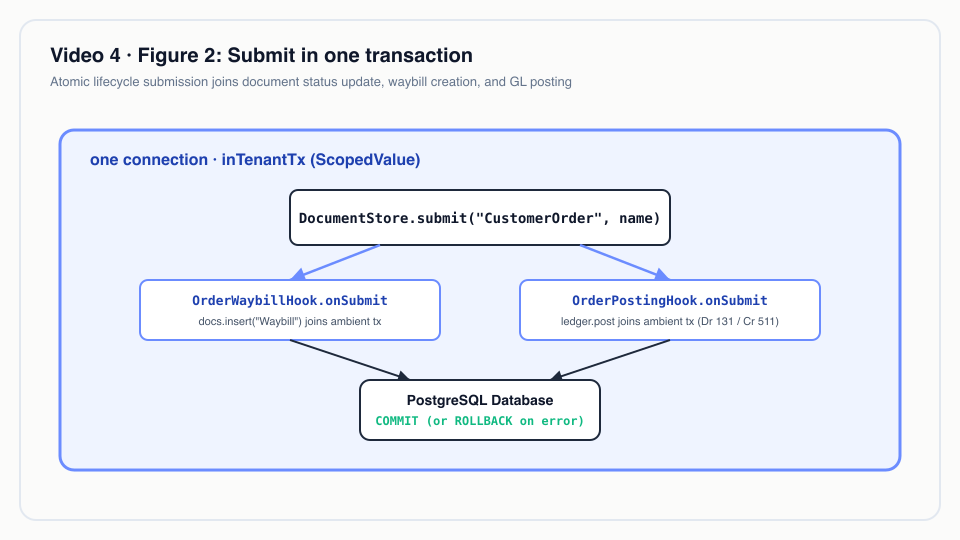 Submit joins the DocumentStore status update, waybill creation, and accounting ledger posting into a single atomic database transaction.
Cancel appends, the database enforces it
LedgerStore.reverse reads the voucher's original lines and inserts their mirror image with
is_reversal = true. It refuses to reverse the same voucher twice.
astra-doctype/src/main/java/io/astra/doctype/ledger/LedgerStore.java
if (reversed) throw new DocValidationException("voucher " + voucherNo + " is already reversed");
if (original.isEmpty()) return null;
LocalDate today = LocalDate.now();
ensurePartition(conn, today);
List<Entry> mirror = original.stream().map(e -> new Entry(e.account(), e.party(), e.credit(), e.debit())).toList();
insert(conn, voucherType, voucherNo, today, mirror, true, "Reversal of " + voucherNo);
Even if application code tried to edit a posted line, PostgreSQL would refuse:
astra-doctype/src/main/resources/db/migration/V3__ledger.sql
-- Corrections are reversal entries, never UPDATE or DELETE; a trigger enforces this for every role,
-- including the table owner. Tenant isolation uses the same row-level security setting as astra_doc.
-- …
CREATE TRIGGER astra_ledger_no_update_delete
    BEFORE UPDATE OR DELETE ON astra_ledger
    FOR EACH ROW EXECUTE FUNCTION astra_ledger_append_only();
The reversal is dated the day of the cancel, not the original posting date. That matches how a closed month is normally corrected: the old period stays as reported, the correction appears in the current one.
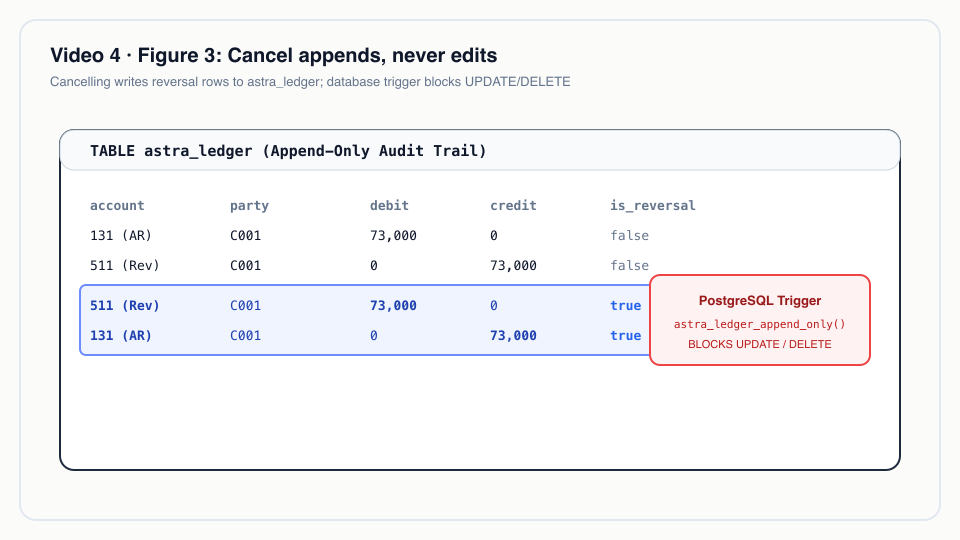 Cancelling an order posts a mirror reversal entry to astra_ledger. A database trigger blocks UPDATE and DELETE, preserving audit history.
Amend: exactly one successor
astra-doctype/src/main/java/io/astra/doctype/store/DocumentStore.java
if (cancelled.docstatus() != 2) throw new DocValidationException("only cancelled documents can be amended");
try (PreparedStatement ps = conn.prepareStatement(
        "SELECT name FROM astra_doc WHERE doctype = ? AND amended_from = ?")) {
    // …
        if (rs.next()) throw new DocValidationException(name + " was already amended as " + rs.getString(1));
}
// Read-only fields belong to the kernel and hooks; the new revision recomputes them.
Map<String, Object> copy = new LinkedHashMap<>(cancelled.data());
def.fields().stream().filter(FieldDefinition::readOnly).forEach(f -> copy.remove(f.name()));
Document draft = new Document(doctype, copy).owner(owner)
        .name(amendedName(cancelled)).amendedFrom(name);
return Optional.of(persistNew(conn, def, draft));
Three design choices are visible here:
- One successor per cancelled version. Two parallel amendments of the same order would give two live
"corrections" of one fact. Refusing the second keeps the chain linear:
ORD-…-00011→-1→-2.amendedNameincrements the suffix when you cancel and amend an amendment. - Read-only fields are dropped.
waybill,shipping_feeandpriced_byare kernel/hook output, so the new draft recomputes them throughbeforeSaverather than inheriting stale values. That is why the amended order shows an empty waybill. - The link is a column.
amended_fromis a real column onastra_doc(V2__amendments.sql), so the chain is queryable without parsing JSON.
Real-world example
A Saigon shop books an Express parcel to Đà Nẵng: C001, Domestic, Express, 2.2 kg, COD 500,000 ₫. These are
the inputs of make demo-express SCENES=4, and ExpressFlowTest asserts the resulting fee is 73,000 ₫.
- Submit (09:00). Sales submits. In one commit: the order becomes
docstatus = 1, waybillWB-…is inserted atCreated, and the ledger gets Debit 131 (C001) 73,000 / Credit 511 73,000. - The customer phones (09:20): wrong receiver address. Editing is refused with 422. The parcel has not
been picked up, so the waybill is still
Created, which is inCANCELLABLE. - Cancel. In one commit: the waybill moves
Created → Cancelled(and gets that milestone in its scan log), the ledger appends Debit 511 / Credit 131 73,000 marked as reversal, the order becomesdocstatus = 2. - Amend. A new draft
ORD-…-1with the same customer data, empty waybill, fee recomputed on save. Sales fixes the address and submits: a new waybill and a new 73,000 entry.
Outputs an auditor sees for C001 on account 131: +73,000, −73,000, +73,000 = 73,000 outstanding, with three lines that each point to a voucher number. The cancelled order, its cancelled waybill and the amendment are all still readable.
If the call had come at 15:00, after the parcel reached a hub, step 3 fails with
cannot cancel …: waybill … is already 'At Hub', and nothing changes: no reversal, no status change. That
veto is the topic of Video 5.
The same pattern fits a bank's maker/checker flow on payment orders or a month-end payroll: once approved, a record is never edited; it is reversed and reissued, and the trail is the data itself.
For technical leaders
- Consistency model. Everything a lifecycle step causes inside PostgreSQL commits or rolls back together.
This is the strongest guarantee you can buy cheaply, and it only holds for writes that go through
DocumentServiceandGeneralLedger. A hook that calls an external HTTP API is outside the transaction; for that, Astra offers Seata AT/TCC per DocType (transaction: global, see Video 17). - Audit by construction. Immutability is enforced twice: in the kernel (
requireDraft) for documents and by a database trigger for ledger rows. Auditors can rely on the database, not on application discipline. - Cost. Every cancel+amend roughly doubles rows for that fact (old doc, new doc, original and reversal lines). For order and accounting volumes this is negligible; monthly ledger partitions keep it manageable.
- Concurrency.
writeusesversion = ?; two people submitting the same draft get one success and oneconcurrent modificationerror, not a double posting. - Hook discipline matters. Long-running work inside
onSubmitholds the transaction (and row locks) open. Measure p95 submit latency and transaction duration per DocType; keep slow integrations out of hooks. - What to measure. Cancel rate and amend rate per DocType (a high rate signals a UX or data-quality problem upstream), share of cancels vetoed by hooks, submit latency.
- When not to use it. Records that are naturally mutable (a customer's phone number, a support ticket's
status) should not be submittable; making them so adds ceremony with no audit value.
Customer,WaybillandSupportTicketin the demo are deliberately not submittable. - Compared with Frappe/ERPNext. Same mental model (
docstatus,amended_from,-1suffix), so ERPNext users transfer directly. Differences: hooks are typed Java in the same transaction rather than Python controllers, the ledger is append-only by trigger, and tenancy is enforced by PostgreSQL row-level security.
Try it yourself
Prerequisites: JDK 25, Docker Desktop with about 8 GB RAM, kubectl, k3d, jq, Bash 5 (brew install bash
on macOS).
make k3d-up                           # cluster, kernel, PostgreSQL, Redis, Keycloak, Seata, CDC worker
make demo-reset && make demo-seed     # two tenants, demo users (password Astra@123)
make demo-express SCENES=4 PAUSE=0    # the API half of this video
open http://localhost:8080/desk/      # sign in as mai, New Customer Order for C001 → Create → Submit → Cancel → Amend
Expected terminal output (numbers depend on the seed date and how many orders exist):
HTTP 201   X-Tx-LSN: 0/…        { "name": "ORD-<date>-000NN", "docstatus": 0 }
HTTP 200   X-Tx-LSN: 0/…        { "name": "ORD-…", "docstatus": 1, "waybill": "WB-<yymm>-0000NN" }
HTTP 422                        { "errors": ["submitted documents are immutable; cancel and amend instead"], "error": "validation" }
HTTP 200   X-Tx-LSN: 0/…        { "name": "ORD-…", "docstatus": 2 }
HTTP 200                        { "name": "WB-…", "ops_status": "Cancelled" }
HTTP 201   X-Tx-LSN: 0/…        { "name": "ORD-…-1", "docstatus": 0, "amendedFrom": "ORD-…", "waybill": null }
The scene does not call amend a second time; to see the rejection, send the same amend request again
(POST /api/doc/CustomerOrder/<original>/amend) and expect HTTP 422 … was already amended as …-1.
The same behaviour is asserted without a cluster in astra-server/src/test/java/io/astra/server/ExpressFlowTest.java
(cancelCascadesAndAmendCreatesRevision, submitCreatesWaybillAndCancelIsVetoedOnceInNetwork); make test
runs the whole suite with Quarkus Dev Services starting PostgreSQL in Docker.
To be accurate
- Thin slice.
CustomerOrderandCODRemittanceare the submittable DocTypes in the Express app. The invoices, payment entries and journal entries described in use-case-01.md for BMS are target scope, not built. - "One transaction" means one PostgreSQL transaction for documents and ledger. When Seata is connected, the credit reservation (separate BMS schema) and the Redis pickup slot join a Seata global transaction around it; that is shown in Video 17, not here.
- Hook order is not configurable.
HookRegistrycalls every hook for the DocType in turn, in the order the CDI container returns them; correctness here relies on all writes sharing the transaction, not on order. - The 58,000 ₫ fee in the Desk scenes comes from the order entered in Desk; the API run uses a different order (2.2 kg, Express, COD 500,000) whose fee is 73,000 ₫.
- Reversals are dated the cancel day. There is no option today to back-date a reversal into the original period.
Figures
- Figure 1 · Three states, one direction
- Figure 2 · Submit in one transaction
- Figure 3 · Cancel appends, never edits
Related
- Previous: Video 3 · Business rules, hooks & validation. Next: Video 5 · Operations, the parcel state machine.
- Deeper: Video 12 · Append-only ledger, Video 17 · Seata global transactions, Video 11 · Keycloak permissions (who may submit and cancel).
- Code excerpts: demo-code-snippets.md, S3.
- Source:
astra-doctype/src/main/java/io/astra/doctype/store/DocumentStore.java,astra-doctype/src/main/java/io/astra/doctype/store/TenantTransactions.java,astra-doctype/src/main/java/io/astra/doctype/ledger/LedgerStore.java,astra-apps/express/src/main/java/io/astra/apps/express/OrderWaybillHook.java,astra-apps/express/src/main/java/io/astra/apps/express/OrderPostingHook.java,astra-spi/src/main/java/io/astra/spi/hook/DocLifecycleHook.java,scripts/demo-express.sh(scene4).