▶ English · Tiếng Việt · 2:24 · Script: demo-video-series.en.md
In one sentence: Astra exposes one MCP endpoint,
/mcp, where an AI agent signs in with the same Keycloak token as its human user, so it gets that user's tenant, row-level security and DocType permissions, and personal data is masked before it reaches the model. Read this if: you want to add an AI tool to an Astra app with one class and no auth code (developer) / you have to decide whether letting an LLM touch business data is safe, auditable and bounded (tech lead).
The problem
Astra Express runs customer care (CARE) for two courier tenants, Saigon and Hanoi. Care staff field calls such as "where is my parcel, and has anyone complained?" Answering means opening the waybill, its scan history, the order behind it and any support tickets, which takes four screens. An AI assistant could do it in one question, but connecting an LLM to business data usually goes wrong in one of three ways:
- A service account with god mode. The assistant gets a database user or an API key that can read every tenant and every table. Whatever the care agent is not allowed to see, the model can still see, and a prompt injection can make it act on that.
- A second permission model. The AI integration re-implements "who can see what" in its own layer. It drifts from the real rules the first time someone adds a role.
- Raw personal data to a third-party model. Receiver names, phone numbers and addresses are sent to the model provider in full, which is hard to defend under Vietnam's personal data protection law or GDPR's data minimisation principle.
Frappe/ERPNext exposes a REST API and lets you script around it, but there is no built-in agent protocol and no masking layer between the data and a model: each integration solves the three problems above on its own.
Astra's answer is that the agent is just another client of the same kernel. It authenticates as the user, every
tool call goes through the same permission checks as the REST API and the Desk, and fields declared pii: true in
the DocType are masked on the MCP channel.
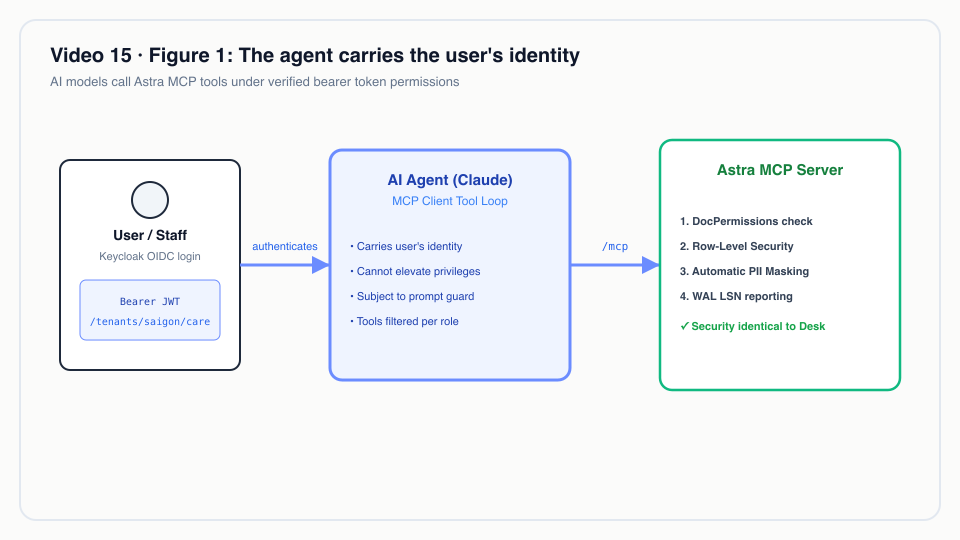 The AI agent accesses Astra over MCP using the caller's verified bearer token, inheriting tenant and role permissions.
What the video shows
| Scene | What you see | What it proves |
|---|---|---|
| Tools | initialize with protocol 2025-11-25, then tools/list returns 7 tools |
5 kernel tools (list_doctypes, search_documents, get_document, create_document, ledger_trial_balance) and 2 contributed by the Express app (track_waybill, cod_outstanding) |
| PII | search_documents for customer C001's orders |
receiver_phone comes back as *******888, receiver_name as B*** A*** K***, the address as 3*** L*** L*** …; shipping_fee (23,000) is unchanged. The signed-in Desk still shows full data |
| Track | Real Claude Code, signed in as ha (care), asked in Vietnamese where parcel WB-2610-000002 is and whether there are complaints |
Claude picks track_waybill by itself and answers with the route (Created → Picked Up → HCM-Tân Bình → HN-Long Biên → Out for Delivery), the order and ticket TCK-00002 |
| Refuse | ha asks Claude to create a new order for C001 |
Claude calls create_document, the kernel answers not permitted: create CustomerOrder; Claude explains the problem is permissions, not data |
| COD | Accountant khoa asks which shops are waiting for COD payouts |
cod_outstanding reads the ledger: Shop Hoa Mai (C001), 350,000 ₫ collected, not yet paid out |
| Code | TrackWaybillTool.java |
An app adds a tool with one class; the kernel handles auth, tenant, RLS, permission checks and masking |
The terminal scene (SCENES=13) also shows two things the narration only touches on: ha calling
cod_outstanding is refused with not permitted: read Account, and ha creating a SupportTicket through MCP
succeeds, with the app's triage hook still raising its priority to High (auto-escalated: mentions 'vỡ').
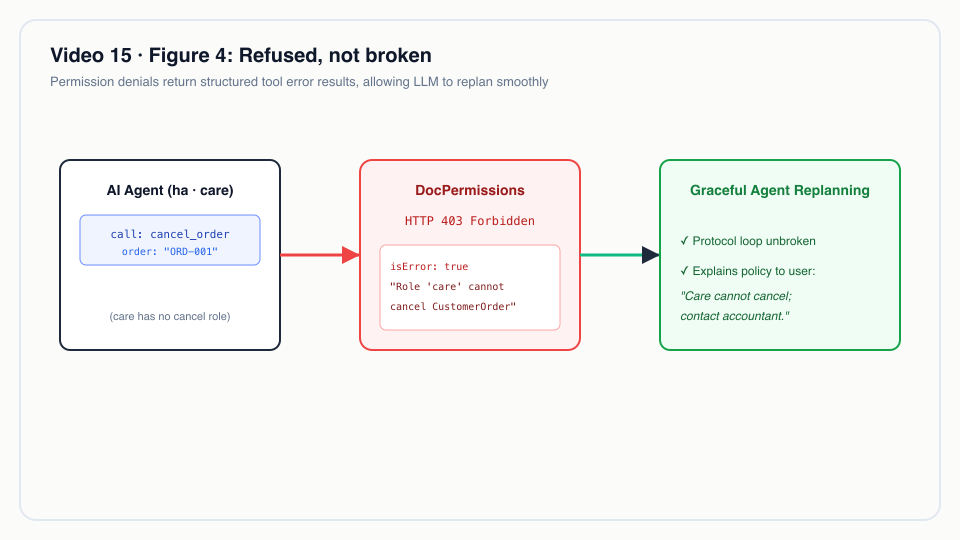 Permission boundaries enforced cleanly: an unauthorized tool invocation returns an informative error without breaking the agent loop.
How it works
One endpoint, same identity
The MCP server is a JAX-RS resource in astra-ai. It speaks JSON-RPC over the Streamable HTTP transport with plain
JSON responses (no server-initiated stream), and it has no authentication code of its own: the bearer token and
X-Astra-Tenant header are validated by the same filters that protect /api/doc, and TenantRequest carries the
resolved user, tenant and roles.
astra-ai/src/main/java/io/astra/ai/McpServer.java
@Path("/mcp")
@RunOnVirtualThread
public class McpServer {

    private static final Logger LOG = Logger.getLogger(McpServer.class);
    static final List<String> PROTOCOL_VERSIONS = List.of("2025-11-25", "2025-06-18", "2025-03-26");
    static final Set<String> KERNEL_TOOLS = Set.of("list_doctypes", "search_documents", "get_document", "create_document",
            "ledger_trial_balance");
    // …

    /** No server-initiated stream: the spec allows 405 for clients that try to open one. */
    @GET
    public Response stream() {
        return Response.status(405).header("Allow", "POST").build();
    }
Kernel tools call the same DocPermissions check as REST before touching the store. That is why ha gets exactly
the answer she would get from the Desk:
astra-ai/src/main/java/io/astra/ai/McpServer.java
    private Object create(Map<String, Object> args) {
        String doctype = required(args, "doctype");
        permissions.require(doctype, tenant.roles(), Action.CREATE);
        if (!(args.get("data") instanceof Map<?, ?> data)) throw new IllegalArgumentException("'data' must be an object");
        Map<String, Object> fields = new LinkedHashMap<>();
        data.forEach((k, v) -> fields.put(String.valueOf(k), v));
        return doc(store.insert(doctype, fields, tenant.userId()));
    }
The rule that refused her lives in the app's DocType, not in any AI code. care may read orders but has no create:
astra-apps/express/src/main/resources/META-INF/astra/doctypes/customer-order.doctype.yaml
permissions:
  - { role: admin,      read: true, create: true, write: true, submit: true, cancel: true }
  - { role: sales,      read: true, create: true, write: true, if-owner: true, submit: true }
  - { role: ops,        read: true }
  - { role: care,       read: true }
  - { role: accountant, read: true, cancel: true }
A refusal is returned as a tool result with isError: true, not as a transport error, so the model can read the
reason and explain it to the user (which is what Claude did in the video):
astra-ai/src/main/java/io/astra/ai/McpServer.java
        } catch (AccessDeniedException | DocValidationException | DocTypeNotFoundException | IllegalArgumentException e) {
            result = toolResult(Map.of("error", String.valueOf(e.getMessage())), true);
            wrote = false;
        }
View source
sequenceDiagram
    participant U as ha (care) in Claude Code
    participant M as Claude (model)
    participant S as Astra /mcp
    participant P as DocPermissions
    participant D as astra_doc (RLS)
    U->>M: "Bưu kiện WB-2610-000002 đang ở đâu?"
    M->>S: tools/call track_waybill {waybill} · Bearer <ha> · X-Astra-Tenant
    S->>P: require READ on Waybill, CustomerOrder, SupportTicket
    P-->>S: ok for role care
    S->>D: read in tenant saigon-express
    D-->>S: waybill, order, tickets
    S->>S: PiiMasking.mask(result)
    S-->>M: masked result
    M-->>U: route, order, ticket TCK-00002
    U->>M: "tạo đơn hàng mới cho C001"
    M->>S: tools/call create_document CustomerOrder
    S->>P: require CREATE on CustomerOrder
    P-->>S: denied
    S-->>M: isError: true, "not permitted: create CustomerOrder"
Masking on the way out
PiiMasking walks the tool result and recognises documents by shape (a map with doctype and data). For each
field the effective DocType (including the tenant overlay) marks pii, it replaces the value:
astra-ai/src/main/java/io/astra/ai/PiiMasking.java
    static Object maskValue(Object v) {
        if (v == null) return null;
        String s = v.toString();
        String digits = s.replaceAll("\\D", "");
        if (digits.length() >= 8 && digits.length() >= s.replaceAll("\\s", "").length() - 2) {
            return "*".repeat(digits.length() - 3) + digits.substring(digits.length() - 3);
        }
        return Arrays.stream(s.trim().split("\\s+"))
                .map(w -> w.isEmpty() ? w : w.substring(0, w.offsetByCodePoints(0, 1)) + "***")
                .collect(Collectors.joining(" "));
    }
Why this design:
- Masking is driven by metadata. The DocType author already says which fields are personal
(
receiver_name,receiver_phone,receiver_addressarepii: trueincustomer-order.doctype.yaml). No AI integration has to keep its own list. - Something useful survives. The last three digits of a phone and the first letter of each word are enough for a care agent to confirm "is this the customer on the line?" without the model ever holding the full value.
- It is applied at the channel, not at storage. The Desk shows full data to the signed-in user; only data leaving through MCP is masked. That keeps the human workflow intact.
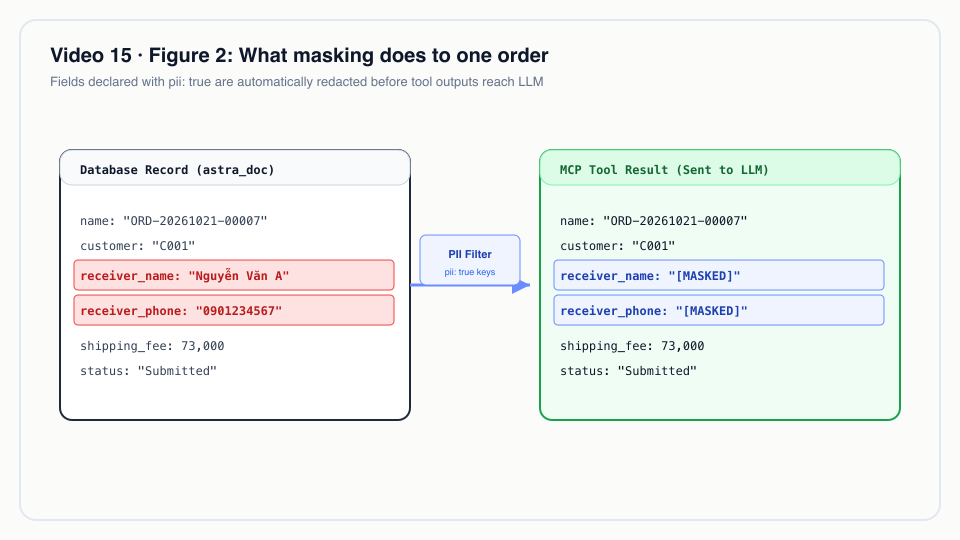 Masking PII on the way out: customer name and phone numbers declared as pii: true are redacted before reaching the model.
An app contributes a tool with one class
The McpTool SPI is in astra-spi, so an app depends on nothing in astra-ai. The tool declares the DocTypes it
reads; the kernel checks read permission on all of them before the tool runs, binds the tenant, logs the call and
masks the result.
astra-apps/express/src/main/java/io/astra/apps/express/TrackWaybillTool.java
@ApplicationScoped
public class TrackWaybillTool implements McpTool {

    @Inject DocumentService docs;

    @Override public String name() { return "track_waybill"; }
    // …
    @Override public List<String> reads() { return List.of("Waybill", "CustomerOrder", "SupportTicket"); }

    @Override public Object call(Map<String, Object> arguments) {
        String name = String.valueOf(arguments.get("waybill"));
        Document waybill = docs.get("Waybill", name).orElseThrow(() -> new IllegalArgumentException("waybill " + name + " not found"));
        Map<String, Object> out = new LinkedHashMap<>();
        out.put("waybill", doc(waybill));
        docs.get("CustomerOrder", waybill.getString("order")).ifPresent(o -> out.put("order", doc(o)));
        out.put("tickets", docs.find("SupportTicket", Map.of("waybill", name), 20).stream().map(TrackWaybillTool::doc).toList());
        return out;
    }

    static Map<String, Object> doc(Document d) {
        return Map.of("doctype", d.doctype(), "name", d.name(), "docstatus", d.docstatus(), "data", d.data());
    }
}
astra-ai/src/main/java/io/astra/ai/AppToolInvoker.java
    public McpTool authorize(String name) {
        McpTool tool = tools.stream().filter(t -> t.name().equals(name)).findFirst()
                .orElseThrow(() -> new IllegalArgumentException("unknown tool: " + name));
        for (String doctype : tool.reads()) permissions.require(doctype, tenant.roles(), Action.READ);
        return tool;
    }
    // …
    public Outcome call(String channel, String name, Map<String, Object> args) {
        McpTool tool = authorize(name);
        LOG.infof("%s tool %s by %s in tenant %s (arguments: %s)", channel, name, tenant.userId(), tenant.tenantId(), args.keySet());
        Object result = TenantContext.call(tenant.tenantId(), () -> pii.mask(tool.call(args)));
        return new Outcome(result, tool.writes());
    }
cod_outstanding declares reads() = List.of("Customer", "Account"). The care role has no rule on Account, so
ha is refused with not permitted: read Account before the tool's code runs; khoa (accountant) can read
Account and gets the ledger balance of account 3388 per shop.
Two design notes worth knowing:
- The permission check is declarative and up front. A tool that reads three DocTypes is refused if the user lacks any one of them, even if this particular call would not have touched it. That is stricter than necessary, but it means a reviewer can audit a tool by reading one line.
- Masking depends on the result shape. The SPI asks tools to return documents as
{doctype, name, data}maps. A tool that flattens a PII field into its own map (for example{"phone": "0901…"}) would bypass masking. Review app tools for this.
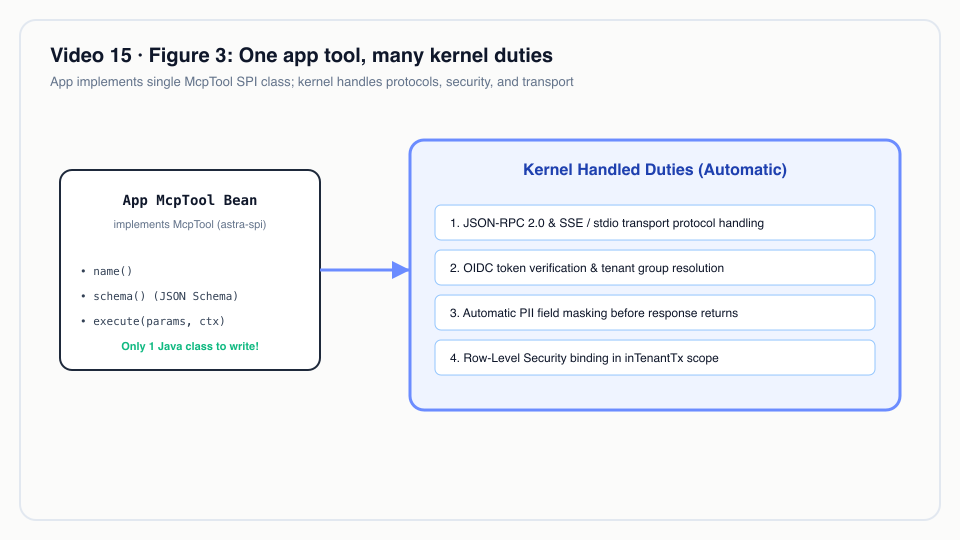 A single McpTool SPI implementation provides tool execution while the kernel handles tenant isolation, permissions, and auditing.
Writes report their WAL position
Every MCP call is a POST, so the kernel adds X-Tx-LSN only after a successful call of a tool that writes
(create_document, or an app tool whose writes() is true). The scene log shows it on the SupportTicket creation
(X-Tx-LSN: 0/432E3F8). This is the same read-your-writes mechanism explained in Video 16.
Real-world example
A 3PL's customer hotline in Ho Chi Minh City. A care agent, signed in as a care user, uses an AI assistant
during calls. The scenario below applies the mechanism above to illustrative values; it is not output from the demo.
Input. A caller says her parcel WB-2611-004211 has not arrived. The agent types: "Where is WB-2611-004211 and
is there an open complaint?"
What Astra does.
- The assistant calls
track_waybill. The kernel checks thatcaremay read Waybill, CustomerOrder and SupportTicket, binds the agent's tenant, and runs the tool. Row-level security means a waybill number from another tenant simply returns "not found". - The order's
receiver_name"Trần Thị Hồng",receiver_phone"0912 345 678" andreceiver_address"12 Nguyễn Huệ, Quận 1" are masked toT*** T*** H***,*******678and1*** N*** H*** Q*** 1***. - The agent asks the caller for the last three digits of her phone; "678" matches the masked value, so the agent has verified the caller without the model ever seeing the full number.
Output. The assistant answers with the scan route and the open ticket. When the caller then asks for a refund
and the agent says "create a refund order", the assistant's create_document call is refused for the same reason
the agent could not do it in the Desk. The log line MCP tool create_document by <user> in tenant <tenant> records
who tried.
For technical leaders
- The security boundary is the user, not the AI. An agent can never do more than the person whose token it carries. That also means it can do everything that person can, including writes allowed by their role. Give agent users the narrowest role that serves the workflow.
- Tokens are the weak point today. The demo client registers a static bearer token that lasts about an hour
(
scripts/mcp-claude.sh). There is no OAuth flow for MCP clients yet, so token handling on the client machine is your responsibility. - Masking is not anonymisation. First letters plus last three digits reduce exposure; they do not make data
anonymous. Fields not marked
pii: true(for example the shop name "Shop Hoa Mai" incod_outstanding) go to the model in full. Treat thepiiflag as part of DocType review. - Masking covers MCP only. The Desk and the REST API return full data to authorised users, which is intended.
- What to measure: tool calls per user and tenant (from the
MCP tool … by … in tenant …log lines), refusal rate (isError: true), which tools are used, and which DocTypes still lackpiiannotations. - When not to use it: if you need the model to see unmasked personal data (for example, drafting a letter to a named customer), this channel will not give it to you, by design. If you need autonomous agents running without a user present, that is not built.
- Compared with alternatives: a hand-written REST wrapper per AI vendor duplicates auth and permission logic; a read-only database replica for the model loses tenant isolation unless you rebuild RLS around it. MCP is an open protocol, so the same endpoint serves Claude, Cursor or an in-house agent.
Try it yourself
Prerequisites: the k3d stack from demo-video-series.en.md
(JDK 25, Docker with 8 GB, kubectl, k3d, jq, Bash 5), and Claude Code (claude) for the agent part.
make k3d-up
make demo-reset && make demo-seed
make demo-express SCENES=13 PAUSE=0
Expected output (abbreviated from the recorded run): protocolVersion: "2025-11-25", a list of 7 tools, masked
receiver_phone values such as *******888, track_waybill with five scans, then
not permitted: create CustomerOrder and not permitted: read Account for ha, and for khoa
[{"customer": "C001", "customer_name": "Shop Hoa Mai", "cod_owed_vnd": 350000.00}].
To talk to it with a real agent:
scripts/mcp-claude.sh ha saigon-express    # registers the "astra" MCP server in Claude Code with ha's token
claude                                     # ask: "Bưu kiện WB-2610-000002 đang ở đâu, có khiếu nại không?"
scripts/mcp-claude.sh khoa saigon-express  # then ask: "Khách nào đang chờ trả COD?"
The script runs claude mcp add --transport http astra http://localhost:8080/mcp with the user's bearer token and
X-Astra-Tenant header. Run it again when the token expires (about one hour). Waybill numbers contain the seed
month, so pick one that exists in your seed.
The integration tests are in astra-server/src/test/java/io/astra/server/McpTest.java (handshake, masking,
permissions, unknown tools) and run with make test.
To be accurate
- The client uses a static bearer token (the dev client's one-hour token). OAuth discovery for MCP is on the roadmap.
- Autonomous AI agents and vector search (pgvector RAG) are on the roadmap, not built.
- PII masking applies to the MCP channel, not to the Desk.
- Claude's answers on screen are real but shortened (the last scan time and SLA deadline were cut); the video labels them as shortened.
- The MCP server answers with JSON only; a client that opens a GET stream gets 405.
Figures
- Figure 1 · The agent carries the user's identity
- Figure 2 · What masking does to one order
- Figure 3 · One app tool, many kernel duties
- Figure 4 · Refused, not broken
Related
- Previous: Video 14 · Tier 2 Wasm · Next: Video 16 · Rust CDC + Sync-Aware LSN
- Video 11 · Keycloak (where roles and DocType permissions come from) · Video 20 · STMS (more app MCP tools)
- Code walkthrough: S9 MCP for AI agents (Vietnamese)
- Background: explain.en.md (AI surface and MCP in the target architecture)
- Source:
astra-ai/src/main/java/io/astra/ai/McpServer.java,astra-ai/src/main/java/io/astra/ai/PiiMasking.java,astra-ai/src/main/java/io/astra/ai/AppToolInvoker.java,astra-spi/src/main/java/io/astra/spi/ai/McpTool.java,astra-apps/express/src/main/java/io/astra/apps/express/TrackWaybillTool.java,astra-apps/express/src/main/java/io/astra/apps/express/CodOutstandingTool.java,scripts/mcp-claude.sh