▶ English · Tiếng Việt · 2:32 · Script: demo-video-series.en.md
In one sentence: Astra is a metadata-driven business kernel; five commands give you a real Kubernetes cluster on a laptop, two seeded courier companies and a Desk generated from the DocTypes the apps contribute. Read this if: you want to run the whole stack locally and know what each pod is for (developer angle) / you want to know what is actually running today, what it costs to operate, and where the line between built and designed sits (tech-lead angle).
The problem
Astra Express is a courier company with two branches run as separate businesses: saigon-express and
hanoi-express. It takes orders (OMS), moves parcels (OPS), answers customer calls (CARE) and collects
cash on delivery (BMS). Each of those is usually a separate product with its own database, login and
integration code. Every new branch or rule turns into a project: a new schema, a new service, a new
deployment.
The usual answer to "show me it works" is a slide deck or a single-container toy that hides the hard
parts: tenancy, identity, transactions across stores, and more than one application server. Teams then
find out in production that their naming counter collides across pods or that tenant isolation was a
WHERE clause someone forgot.
Frappe/ERPNext solved the first half of this with one idea: the application is metadata. A DocType describes a business record, and the forms, API and permissions come from it. Astra keeps that idea, rebuilt in Java 25 on Quarkus, and adds the constraints a cluster brings (explain.en.md). Video 1 exists to show that the starting point is a real cluster, not a toy: two kernel pods from the first command, so tenancy and naming series have to be cluster-safe from day one.
What the video shows
| Scene | What you see | What it proves |
|---|---|---|
| Architecture | The README diagram: kernel, DocType Engine, Plugin Host | Apps plug in through metadata; the narration separates what runs from what is design |
| Prerequisites | JDK 25, Docker Desktop, kubectl, k3d, jq, Bash 5; Rust only for Wasm |
The toolchain is ordinary; no proprietary installer |
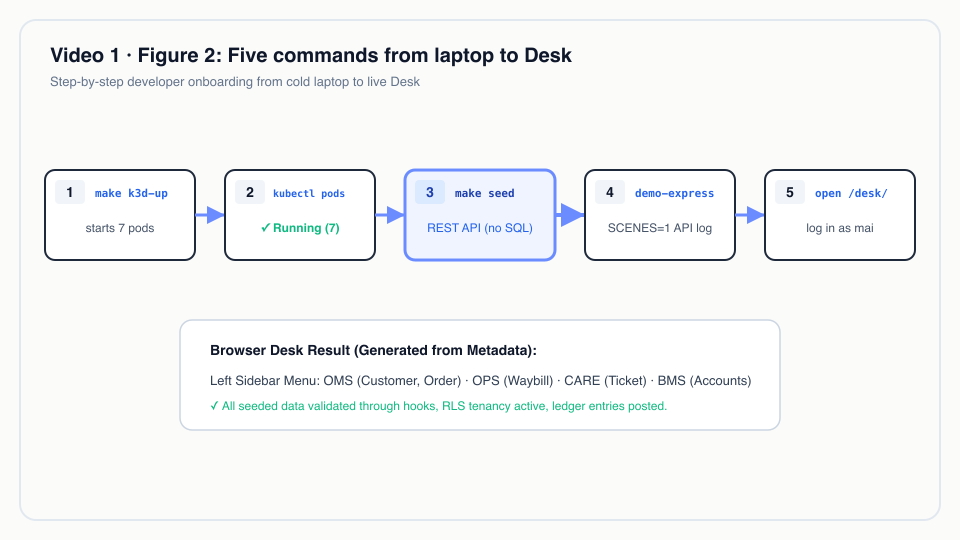
make k3d-up |
Real output, sped up; the cluster already existed, so it rebuilt three images and redeployed every pod in 1 minute 29 seconds | One command builds and deploys the whole stack |
kubectl -n astra get pods |
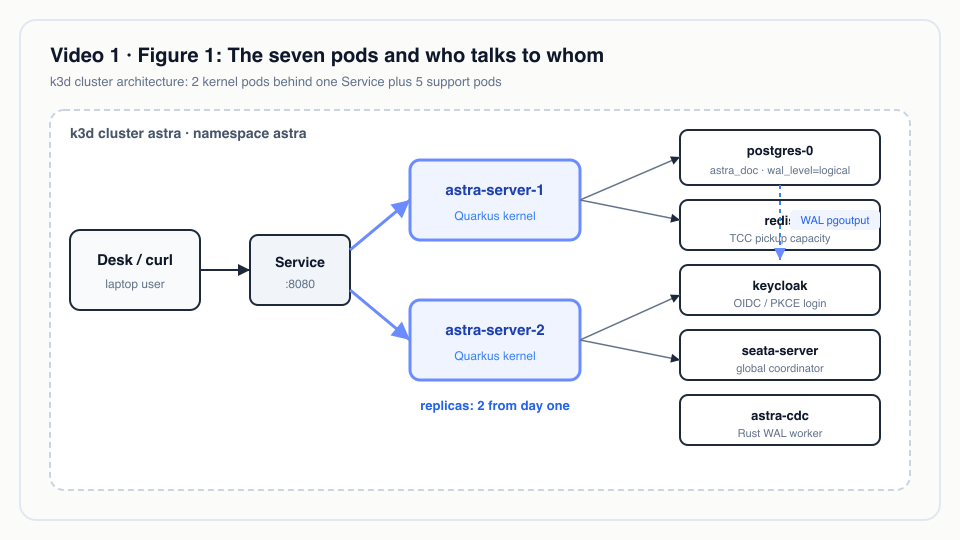
Seven pods, all Running |
Two kernel pods behind one Service, plus PostgreSQL, Redis, Keycloak, Seata and the Rust CDC worker |
make demo-seed |
Two courier companies loaded | All data goes through the REST API with Keycloak logins; hooks, lifecycle, ledger and overlays run during the load; no SQL |
Scene 1 of demo-express |
/api/app and /api/doctype |
At recording time: one server, two apps, eight DocTypes across OMS, OPS, CARE, BMS and CMS |
| Desk | Login as mai, Installed apps, left menu |
The menu is generated from the DocTypes the app contributes |
How it works
One server, apps compiled in
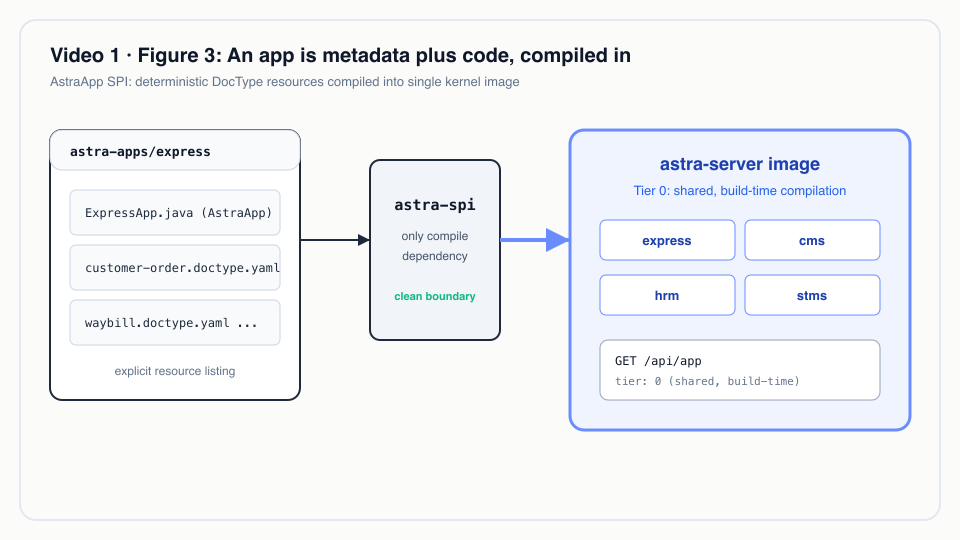
An app is a CDI bean that implements the AstraApp SPI and lists its DocType YAML files. It depends
only on astra-spi, never on kernel internals.
astra-spi/src/main/java/io/astra/spi/app/AstraApp.java
public interface AstraApp {

    /** Stable, reverse-DNS style identifier, e.g. {@code io.astra.cms}. */
    String id();

    /** Semantic version of this app build. */
    String version();

    /**
     * Classpath resource paths of DocType definitions (YAML) this app contributes,
     * e.g. {@code META-INF/astra/doctypes/article.doctype.yaml}. Explicit listing keeps
     * loading deterministic inside jars and native images.
     */
    List<String> doctypeResources();
}
astra-apps/express/src/main/java/io/astra/apps/express/ExpressApp.java
@ApplicationScoped
public class ExpressApp implements AstraApp {

    @Override
    public String id() { return "io.astra.express"; }

    @Override
    public String version() { return "0.1.0"; }

    @Override
    public List<String> doctypeResources() {
        return List.of(
                "META-INF/astra/doctypes/customer.doctype.yaml",
                "META-INF/astra/doctypes/customer-order.doctype.yaml",
                // …
                "META-INF/astra/doctypes/pricing-rule.doctype.yaml");
    }
}
The server module depends on each app module, so the apps are compiled into one image. That is what the
API reports as tier 0 (shared, build-time):
astra-doctype/src/main/java/io/astra/doctype/api/AppResource.java
    @GET
    public List<Map<String, Object>> list() {
        return apps.apps().stream().map(app -> {
            Map<String, Object> m = new LinkedHashMap<>();
            m.put("id", app.id());
            m.put("version", app.version());
            m.put("tier", "0 (shared, build-time)");
            m.put("doctypes", registry.namesByApp(app.id()));
            return m;
        }).toList();
    }
Why explicit resource lists instead of classpath scanning: the javadoc says it keeps loading deterministic inside jars and native images. You always know which DocTypes an app brings by reading one method.
What make k3d-up actually does
The Makefile target calls scripts/k3d-up.sh. It creates or reuses the k3d
cluster astra, builds the Maven modules, builds three images (server, Keycloak with the Astra theme,
Rust CDC worker), imports them into k3d, applies deploy/k8s/base, prepares the database with
scripts/db-setup.sh, syncs the Keycloak realm, and restarts the deployments so a re-imported image with
the same tag is picked up.

View source
flowchart LR
    dev["make k3d-up"] --> mvn["./mvnw package"]
    mvn --> img["docker build<br/>astra/server · astra/keycloak · astra/cdc"]
    img --> imp["k3d image import"]
    imp --> k8s["kubectl apply -k deploy/k8s/base"]
    k8s --> db["scripts/db-setup.sh k3d<br/>BMS schema, CDC role"]
    db --> kc["keycloak-sync-realm.sh"]
    kc --> srv["rollout astra-server (2 pods)"]
    srv --> pub["db-setup.sh k3d again<br/>CDC publication"]
    pub --> cdc["rollout astra-cdc"]
The CDC publication is created after the server has started because the server's Flyway migrations
create the tables the publication covers; the script comments say so directly
(# now the CDC publication, on the migrated schema).
Seven pods, and why two of them are the kernel
deploy/k8s/base/astra-server.yaml
replicas: 2 # two pods from the start: tenancy and naming series must be cluster-safeEvery other workload in deploy/k8s/base (PostgreSQL, Redis, Keycloak, Seata, CDC) runs one replica, which
gives the seven pods in the video. Starting with two kernel pods is a deliberate test condition: a
counter kept in memory, or a cache that assumes one writer, breaks immediately. The naming series is
stored in PostgreSQL per tenant (astra_series), which is why order numbers stay unique across pods
(Video 10 proves it under load).
| Pod | Role in the demo |
|---|---|
astra-server ×2 |
Quarkus kernel: REST, Desk, MCP, hooks, DocType engine |
postgres-0 |
astra_doc, ledger, BMS schema, replicas; wal_level=logical for CDC |
redis |
TCC pickup capacity (Video 17) |
keycloak |
OIDC login, per-tenant roles as groups (Video 11) |
seata-server |
Global transaction coordinator (Video 17) |
astra-cdc |
Rust worker decoding pgoutput into replica tables (Video 16) |
Seeding through the front door
scripts/demo-seed.sh signs in through Keycloak as the demo user and
creates everything with HTTP calls. Nothing is inserted with SQL:
scripts/demo-seed.sh
customer() { call "$1" POST /api/doc/Customer "$2" >/dev/null; echo "  customer $(jq -r .code <<<"$2")"; }
order()    { call "$1" POST /api/doc/CustomerOrder "$2" | jq -r .name; }
submit()   { call "$1" POST "/api/doc/CustomerOrder/$2/submit" | jq -r .data.waybill; }
scan()     { call "$1" PUT "/api/doc/Waybill/$2" "$3" >/dev/null; }
Why this matters: seed data that bypasses the API also bypasses validation, hooks, permissions and the ledger. Seeding through the API means the demo data was produced by the same rules a user hits, so a fee or a journal entry you see in Desk was computed, not typed in.
Desk knows nothing in advance
Desk is a static page served by the kernel (astra-server/src/main/resources/META-INF/resources/desk/).
After login it asks /api/doctype for the tenant's effective DocTypes and builds the left menu by
module. Video 2 covers the form renderer; the point for Video 1 is that installing an app is enough for
its DocTypes to show up.

View source
sequenceDiagram
    autonumber
    actor M as mai (admin, saigon-express)
    participant D as Desk (browser)
    participant KC as Keycloak
    participant K as astra-server
    M->>D: open /desk/
    D->>KC: login (PKCE)
    KC-->>D: token with /tenants/saigon-express/admin
    D->>K: GET /api/app, GET /api/doctype (Bearer, X-Astra-Tenant)
    K-->>D: apps + DocType definitions (overlay applied)
    D->>D: sidebar grouped by module: OMS, OPS, CARE, BMS
Real-world example
Illustrative scenario: the company, people and values are made up; the mechanism and the rules it applies are the real ones shown above.
A regional third-party logistics company in Vietnam runs two legal entities, one in Hanoi and one in Ho Chi Minh City, and its CTO wants a proof of concept before committing a team. The question is narrow: can one platform serve both entities with separate data, real logins and the company's own order rules?
Inputs:
- A laptop with Docker Desktop given 8 GB of RAM, JDK 25,
kubectl,k3d,jq, Bash 5. - The repository, unchanged.
What Astra does, in order:
make k3d-upbuilds and deploys seven pods.make demo-seedcreates the two tenants' data through the API. Insaigon-expressit creates, among others, customerC001"Shop Hoa Mai" (segment B2B, credit limit 2,000,000 ₫) and posts orders that are priced by the shipping-fee hook and, when submitted, create waybills and ledger entries.- Signing in as
mai(admin) shows onlysaigon-express;nam(admin) sees onlyhanoi-express.
Outputs the CTO can check in about half an hour:
kubectl -n astra get pods: twoastra-serverpods plus the five infrastructure pods.GET /api/app: the apps compiled into the image and their DocTypes.- Desk at
http://localhost:8080/desk/: orders, operations, customer care and accounting menus, generated from metadata.
What the proof of concept does not answer, and should not be stretched to answer: throughput, upgrade behaviour, or production hardening. Those need their own tests.
For technical leaders
- What you are evaluating. A thin slice that runs end to end: DocType engine, hooks, lifecycle, ledger, overlays, Wasm sandbox, MCP, CDC, Seata, Keycloak, two kernel pods. The README's Project Status is the authority on what runs; the rest of the README is target architecture.
- Operational footprint. Seven pods for one demo environment, with Keycloak, Seata and a CDC worker
each being a system to patch and monitor. If you do not need distributed transactions or a read replica,
that is cost without benefit; the kernel uses Seata only when a DocType declares
transaction: globaland a coordinator is available. - Build-time apps. Every app today is Tier 0: compiled into the image. Adding or changing an app means a new image and a rollout. Runtime loading (Tier 1 isolated JVM) and versioned side-by-side apps are roadmap.
- What to measure in a pilot. Time from
git cloneto a working Desk on a clean machine; time for a developer to add one DocType and one hook (Videos 2, 3, 9); whether your security team accepts row-level security as the tenant boundary (Videos 7, 8). - When not to use it. If you need a finished ERP today, ERPNext is a mature product and Astra is not. If one tenant and one database are enough, a conventional Spring or Quarkus service is simpler to run.
- Compared with Frappe/ERPNext. Same core idea (DocType as metadata, apps, submittable documents). Different storage (one JSONB table, no DDL per field), Java 25 virtual threads instead of Python workers, and row-level security instead of one database per site. Astra is clean-room: no code, schema or assets from either project.
Try it yourself
Prerequisites: JDK 25, Docker Desktop with about 8 GB of RAM allocated, kubectl, k3d, jq and Bash 5
(brew install bash on macOS; the scripts re-run themselves under Bash 5 if the default shell is 3.2).
Rust is only needed to change the Wasm modules or the CDC worker locally.
make k3d-up                                # cluster, images, deploy, wait
kubectl -n astra get pods                  # expect 7 pods Running: astra-server x2, postgres-0, redis, keycloak, seata-server, astra-cdc
make demo-seed                             # seed saigon-express and hanoi-express through the REST API
make demo-express SCENES=1 PAUSE=0         # /q/health/ready, /api/app, /api/doctype
open http://localhost:8080/desk/           # log in as mai / Astra@123
Expected output of the scene (abridged):
━━━ Scene 1 · One server, many apps ━━━
$ curl -X GET http://localhost:8080/q/health/ready …
HTTP 200
"UP"
$ curl -X GET http://localhost:8080/api/app …
HTTP 200
[ { "id": "io.astra.express", "version": "0.1.0", "tier": "0 (shared, build-time)", "doctypes": [ "Customer", "CustomerOrder", … ] }, … ]
To run it again from a clean state, make demo-reset && make demo-seed. scripts/demo-reset.sh targets
the k3d database when its PostgreSQL pod exists and Docker Compose otherwise; it uses the local bootstrap
superuser, so never point it at real data. make k3d-down deletes the cluster.
To be accurate
- Counts in the video reflect the recording. The video shows two apps and eight DocTypes (Express and
CMS). The current server image also bundles the HRM and STMS apps, so
/api/appnow returns four apps and/api/doctypereturns more DocTypes. - The 1 minute 29 seconds was a rebuild on a machine where the cluster already existed. A first run also pulls base images and creates the cluster, and takes longer.
- Tier 0 only for compiled apps. Tier 2 Wasm runs (Video 14). Tier 1 isolated JVM loading, versioned apps side by side, canary rollout and automatic rollback are roadmap, marked ○ or ◐ in the README.
- Desk is a demo UI generated from metadata: list, form, lifecycle, ledger, replica and overlay views. Dashboards, reports and the full Desk are not built.
- k3d is a local cluster. The manifests in
deploy/k8s/baseare not a production deployment: no managed database, no backups, no high availability for PostgreSQL or Keycloak.
Figures
- Figure 1 · The seven pods and who talks to whom
- Figure 2 · Five commands from laptop to Desk
- Figure 3 · An app is metadata plus code, compiled in
Related
- Next: Video 2 · DocType: from one YAML file to API, UI and indexes
- Then: Video 3 · Business rules: hooks & validation
- Script and recording setup: demo-video-series.en.md
- Why the design looks like this: explain.en.md
- What runs today: README Project Status
- Source:
scripts/k3d-up.sh,scripts/demo-seed.sh,scripts/demo-express.sh,deploy/k8s/base,AstraApp.java,AppResource.java