▶ English · Tiếng Việt · 2:28 · Script: demo-video-series.en.md
In one sentence: One Astra server hosts many companies; the kernel decides which tenant a request belongs to, carries that decision in a Java
ScopedValueinto a transaction-local PostgreSQL setting, and row-level security returns zero rows whenever that setting is missing.Read this if: you write Astra apps and want to know why no API takes a
tenantparameter (developer angle) / you are choosing between shared-schema, database-per-tenant and instance-per-tenant SaaS and want to know where the isolation boundary actually sits (tech-lead angle).
The problem
Astra Express, the demo's courier company, runs as two tenants on one platform: saigon-express and
hanoi-express. Both have a customer called C001. In Saigon it is "Shop Hoa Mai"; in Hanoi it is
"Nhà sách Tràng Tiền". Both create orders, waybills and COD remittances through the same URLs and the same
DocTypes. Some people work for both: the demo user is an admin in each.
The pain in a shared-schema SaaS is well known. Isolation usually lives in application code: every query
needs a WHERE tenant_id = ?, every repository method takes a tenant argument, and every new developer,
background job, report or AI tool is one more place where that filter can be forgotten. The failure mode is
silent: a missing filter does not throw; it returns another company's customers.
The usual alternatives trade that risk for operating cost:
- Database or instance per tenant. Frappe/ERPNext does this: a bench hosts many sites, each with its own database. Isolation is strong, but every site is migrated, backed up and monitored separately, and cross-site work (a dispatcher serving two branches) means two logins.
- Shared tables with an ORM filter. Cheap to run, but the boundary is only as strong as the most careless query, including raw SQL in reports and hooks.
Astra's thin slice takes the shared-table route but moves the boundary out of application code into two places the application cannot skip: the kernel's request filter and PostgreSQL row-level security (RLS).
What the video shows
| Scene | What you see | What it proves |
|---|---|---|
| 1 · Title | "One server, many companies." | Framing. |
| 2 · List | demo opens /desk/compare.html, Screen #/list/Customer. Two panes, same URL, same DocType. Saigon shows 3 customers, Hanoi 2. |
Each pane calls the same API with a different X-Astra-Tenant header; the data differs. |
| 3 · Form | #/form/Customer/C001 in both panes. |
The same document name is two separate records. Uniqueness is (tenant_id, doctype, name). |
| 4 · Resolve | The resolution order: header, subdomain, the user's only tenant. Unresolved: 400. Non-member: 403. | No API takes the tenant as a parameter; the kernel resolves it once per request. |
| 5 · Links | GET Customer/C003 as Hanoi returns 404; a Hanoi order pointing at C003 fails with field 'customer': Customer 'C003' not found. |
Link validation sees only the current tenant's rows. |
| 6 · Members | nam (Hanoi admin) calling Saigon gets 403 not a member of tenant saigon-express; demo without a header gets 400. |
Fail-closed: if the tenant is ambiguous, the kernel refuses rather than guesses. |
| 7 · RLS | In psql as the application role: visible_rows = 0 without a tenant; after set_config('astra.tenant','saigon-express',true), counts per DocType (Customer 3, CustomerOrder 7, Waybill 5, …). |
The database itself enforces the boundary, even for raw SQL. |
| 8 · Code | TenantContext, TenantTransactions, RowLevelSecurityGuard. |
The tenant follows the call flow, not the argument list. |
| 9 · Recap | Four layers: one URL, Links, Keycloak per tenant, zero rows without a tenant. |
The terminal half of the video is make demo-express SCENES=7. The captured run
(docs/video/v07-tenants/assets/scene-07.log) shows exactly these responses:
$ curl -X GET http://localhost:8080/api/doc/Customer -H "Authorization: Bearer <nam>" -H "X-Astra-Tenant: saigon-express"
HTTP 403
{ "error": "not a member of tenant saigon-express" }
$ curl -X GET http://localhost:8080/api/doc/Customer -H "Authorization: Bearer <demo>"
HTTP 400
{ "error": "tenant could not be resolved; send X-Astra-Tenant or use a tenant subdomain" }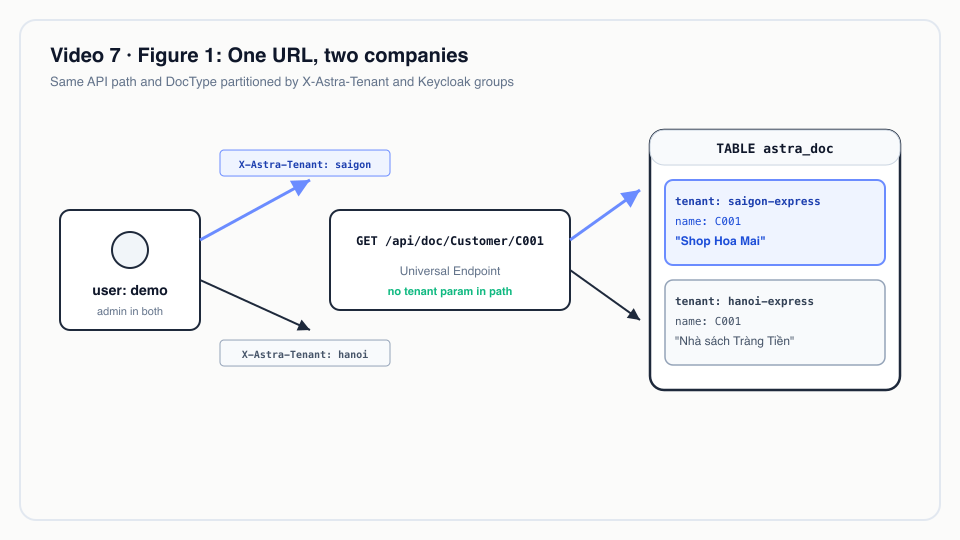 One URL, two companies: same hostname, but Keycloak groups and X-Astra-Tenant keep data strictly partitioned.
How it works
The path from HTTP request to SQL row has four steps. Each one is a place where the tenant is either established or enforced, never passed in by the caller.

View source
sequenceDiagram
    participant C as Client (Desk / curl / MCP)
    participant F as TenantResolverFilter
    participant R as DocResource
    participant T as TenantTransactions
    participant P as PostgreSQL (RLS)
    C->>F: Bearer JWT (groups /tenants/<t>/<role>) + optional X-Astra-Tenant
    F->>F: header → subdomain → only membership
    alt unresolved
        F-->>C: 400
    else not a member
        F-->>C: 403
    end
    F->>R: tenantRequest.tenantId(t), roles
    R->>R: TenantContext.call(t, work)  (ScopedValue)
    R->>T: inTenantTx(work)
    T->>P: BEGIN; set_config('astra.tenant', t, true)
    T->>P: SELECT/INSERT … (no tenant filter in SQL)
    P-->>T: only rows where tenant_id = current_setting('astra.tenant')
    T->>P: COMMIT (setting disappears)
Step 1: resolve the tenant, once, from trusted inputs
astra-kernel/src/main/java/io/astra/kernel/tenant/TenantResolverFilter.java
Memberships memberships = Memberships.of(identity);
String tenant = fromHeader(ctx).or(() -> fromHost(ctx)).or(() -> onlyMembership(memberships)).orElse(null);
if (tenant == null && "single".equals(mode)) {
    tenant = defaultTenant;
}
if (tenant == null || !tenant.matches("[a-z0-9][a-z0-9-]{0,62}")) {
    ctx.abortWith(error(Response.Status.BAD_REQUEST, "tenant could not be resolved; send "
            + TENANT_HEADER + " or use a tenant subdomain"));
    return;
}
Set<String> roles = memberships.roles(tenant);
if (roles.isEmpty()) {
    ctx.abortWith(error(Response.Status.FORBIDDEN, "not a member of tenant " + tenant));
    return;
}
Why this shape:
- The header is a hint, not an authority. A client may name a tenant, but membership is checked
against the verified bearer token. Memberships come from Keycloak group paths of the form
/tenants/<tenant>/<role>(astra-kernel/src/main/java/io/astra/kernel/security/Memberships.java), so roles are always per tenant:namis an admin, but only inhanoi-express. - A single-tenant user never has to say anything.
onlyMembershippicks the one tenant a user belongs to, so a user likenam, who belongs only tohanoi-express, does not need a header. - Ambiguity is an error. A user in two tenants who sends nothing gets 400 instead of "the first tenant", because a guess is exactly how data ends up in the wrong company.
- Subdomain resolution exists but is off by default.
fromHostonly runs whenastra.tenancy.base-domainis set; inastra-server/src/main/resources/application.ymlit is commented out.
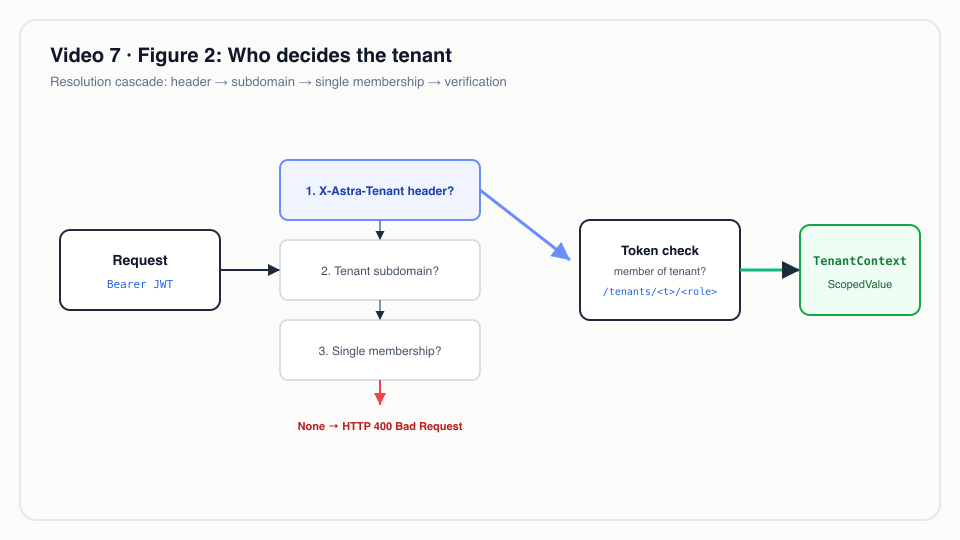 Resolving the tenant: the OIDC token establishes group membership, and the request header selects which tenant is active.
Step 2: carry the tenant in a ScopedValue, not in arguments
astra-spi/src/main/java/io/astra/spi/tenant/TenantContext.java
/**
 * The current tenant, carried in a Java 25 {@link ScopedValue}. The kernel binds it once per request;
 * every kernel service reads it from here. No kernel API accepts a tenant as a caller-supplied
 * parameter, which is what makes cross-tenant access impossible from app code.
 */
public final class TenantContext {

    private static final ScopedValue<String> TENANT = ScopedValue.newInstance();
    // …
    /** The bound tenant; throws when no tenant is in scope, which is always a programming error. */
    public static String require() {
        if (!TENANT.isBound()) {
            throw new IllegalStateException("No tenant bound in the current scope");
        }
        return TENANT.get();
    }
Resources bind it around each kernel call:
astra-doctype/src/main/java/io/astra/doctype/api/DocResource.java
/** Binds the request's tenant into the ScopedValue scope for the duration of the kernel call. */
private <T> T scoped(ScopedValue.CallableOp<T, RuntimeException> work) {
    return TenantContext.call(tenant.tenantId(), work);
}
Why a ScopedValue rather than a ThreadLocal or a parameter:
- A parameter can be supplied by app code, so an app hook could ask for another tenant's data. The
DocumentServiceSPI that hooks use has no tenant argument at all. - A
ThreadLocalcan be set and forgotten, and leaks between pooled threads. AScopedValueis immutable inside its scope and unbound outside it, which fits virtual threads: there is nothing to clean up. TenantContextlives inastra-spi, so apps can read the tenant (for example to log it) but the only way to bind one is the call that wraps their code.
Step 3: turn the scope into a transaction-local database setting
astra-doctype/src/main/java/io/astra/doctype/store/TenantTransactions.java
String tenant = TenantContext.require();
try (Connection conn = dataSource.getConnection()) {
    conn.setAutoCommit(false);
    try {
        try (PreparedStatement ps = conn.prepareStatement("SELECT set_config('astra.tenant', ?, true)")) {
            ps.setString(1, tenant);
            ps.execute();
        }
        T result = ScopedValue.where(TX, conn).call(() -> work.run(conn));
        conn.commit();
        return result;
    } catch (Exception e) {
        conn.rollback();
        // …
The third argument of set_config is true: the setting is local to the transaction. When the
connection goes back to the pool, the tenant goes with the commit or rollback. The next request that
borrows the connection starts with no tenant, which (step 4) means it sees nothing until it binds its own.
The open connection is also carried in a ScopedValue, so a hook that writes a Waybill while an order is
being submitted joins the same transaction and the same tenant.
Step 4: let PostgreSQL enforce it
astra-doctype/src/main/resources/db/migration/V1__astra_doc.sql
ALTER TABLE astra_doc ENABLE ROW LEVEL SECURITY;
ALTER TABLE astra_doc FORCE ROW LEVEL SECURITY;   -- applies to the table owner too

CREATE POLICY astra_doc_tenant_isolation ON astra_doc
    USING      (tenant_id = current_setting('astra.tenant', true))
    WITH CHECK (tenant_id = current_setting('astra.tenant', true));
current_setting('astra.tenant', true)returns NULL when nothing is bound;tenant_id = NULLis never true, so the result is zero rows, not an error and not all rows. That is scene 7'svisible_rows = 0.WITH CHECKstops a write from landing in another tenant even if the insertedtenant_idwere wrong.FORCEmatters because the application role owns the tables Flyway creates; withoutFORCE, PostgreSQL exempts the owner from its own policies.- The same pattern is applied in later migrations:
astra_series(V1), the ledger (V3), overlays (V4) and the CDC replica tables (V5) all useFORCE ROW LEVEL SECURITY.
This is why Link validation needs no tenant filter. The query that rejects Hanoi's order for C003 does
not mention a tenant at all:
astra-doctype/src/main/java/io/astra/doctype/store/DocumentStore.java
try (PreparedStatement ps = conn.prepareStatement(
        "SELECT 1 FROM astra_doc WHERE doctype = ? AND name = ?")) {
    ps.setString(1, f.options().getFirst());
    ps.setString(2, target);
    try (ResultSet rs = ps.executeQuery()) {
        if (!rs.next()) errors.add("field '" + f.name() + "': " + f.options().getFirst() + " '" + target + "' not found");
    }
}
C003 exists, but only under saigon-express. Inside Hanoi's transaction, RLS hides it, so it is
"not found". The SQL author did not have to remember anything.
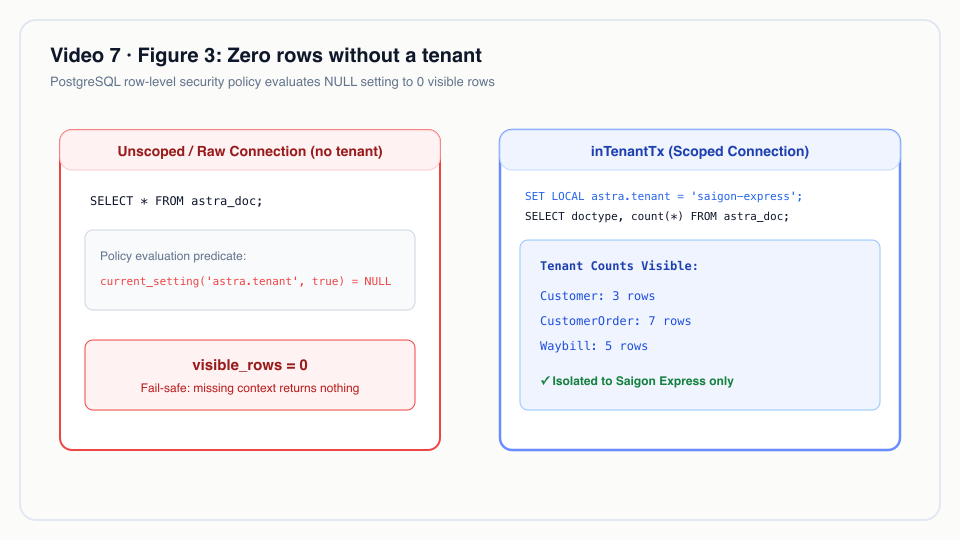 Row-level security enforces isolation at the database level: a query without a tenant context returns zero rows.
The safety net
All of the above assumes the database role is actually subject to RLS. PostgreSQL superusers and roles
with BYPASSRLS ignore every policy. RowLevelSecurityGuard checks this at startup and stops the kernel;
that is the subject of Video 8.
Real-world example
Illustrative scenario: the company, people and values are made up; the mechanism and the rules it applies are the real ones shown above.
A 3PL platform in Vietnam hosting several courier brands. A logistics software vendor runs one Astra cluster for three regional courier companies. Each is a tenant. A freelance dispatcher, Linh, is contracted by two of them.
Inputs:
- Keycloak groups for Linh:
/tenants/hanoi-express/dispatcherand/tenants/saigon-express/dispatcher. - Both tenants have a customer
C001and an order seriesORD-.YYYYMMDD.-.#####. - A careless report written by the vendor's analyst:
SELECT count(*) FROM astra_doc WHERE doctype = 'CustomerOrder'.
What Astra does:
- Linh opens Desk without choosing a company and calls
GET /api/doc/CustomerOrder. She is in two tenants and sent no header, so the kernel answers400 tenant could not be resolved. The client has to make her pick. - She picks Hanoi (
X-Astra-Tenant: hanoi-express). The filter checks her token, finds the dispatcher role there, and bindshanoi-expressfor the call. - She creates an order for
C001. Link validation finds Hanoi'sC001. The order number comes from Hanoi's own counter row inastra_series, so Saigon's numbering is unaffected. - The analyst's report, run through the kernel, counts only the bound tenant's orders. Run directly as
the application role with no tenant bound, it returns
0.
Outputs: one order in Hanoi, no change visible in Saigon, a report that cannot over-count, and no code
anywhere that had to remember WHERE tenant_id = ?.
Contrast with a database-per-site model: Linh would hold two logins and the vendor would run three databases, three migration runs and three backup schedules for the same schema.
For technical leaders
- Where the boundary is. Two independent layers: the kernel filter (who may act in which tenant) and
PostgreSQL RLS (which rows a transaction can touch). A bug in app code cannot cross tenants because app
code never chooses the tenant. A bug in the kernel filter is still caught by RLS for anything that runs
inside
inTenantTx. - What it costs. One extra
set_configstatement per transaction, and every query evaluated with the RLS predicate. The unique key and the list index inV1__astra_doc.sqlboth start withtenant_id, which keeps that predicate cheap for name lookups and lists. No benchmark of RLS overhead is published in the repo; measure it on your workload. - Operational benefit. One schema, one migration run, one backup, one connection pool for all tenants. Onboarding a tenant in the demo is creating Keycloak groups and data, not provisioning a database.
- What to measure. 400 and 403 rates per client (a spike means a client lost its tenant selection), queries that return zero rows unexpectedly (a missing tenant scope), and per-tenant row counts on the largest tables (noisy neighbours).
- Risks.
- Code that bypasses
TenantTransactions(a rawDataSourcecall) gets zero rows rather than leaked rows. That is the safe direction, but it can look like a bug. - Noisy neighbours share CPU, I/O and the connection pool. Per-tenant bulkheads and quotas are design targets, not built (see "To be accurate").
- RLS protects rows, not everything: caches, logs, files and search indexes need their own tenant keys.
- Code that bypasses
- When not to use shared-schema RLS. Customers with contractual data-residency, dedicated-key or
"own database" requirements. The design names
database-per-tenantandcluster-per-tenantprofiles for them; neither is built. - Compared with Frappe. Frappe isolates by site and database; Astra isolates by row inside one database and treats multi-company users as first-class. Frappe's model is simpler to reason about per customer; Astra's is cheaper to operate at many tenants.
Try it yourself
Prerequisites: JDK 25, Docker (8 GB for the full stack), kubectl, k3d, jq, Bash 5.
make k3d-up                                  # 2 kernel pods, PostgreSQL, Redis, Keycloak, Seata, CDC
make demo-reset && make demo-seed            # tenants saigon-express and hanoi-express
open http://localhost:8080/desk/compare.html # log in as demo / Astra@123 first
make demo-express SCENES=7 PAUSE=0           # the terminal half of the video
In compare.html, set Screen to #/list/Customer and then #/form/Customer/C001. Expected: Saigon
lists 3 customers and Hanoi 2; C001 is "Shop Hoa Mai" in Saigon and "Nhà sách Tràng Tiền" in Hanoi.
Expected from scene 7, in order: two HTTP 200 reads of C001 with different names; HTTP 404 for
C003 in Hanoi; HTTP 422 with field 'customer': Customer 'C003' not found; HTTP 403 for nam on
Saigon; HTTP 400 for demo without a header; then in SQL visible_rows = 0 followed by per-DocType
counts for Saigon. The SQL part runs only when the script can reach the database (DB=k3d or
DB=compose, detected automatically in scripts/demo-express.sh).
The integration test astra-server/src/test/java/io/astra/server/TenantIsolationTest.java covers the same
rules without the demo stack: make test.
To be accurate
- Built: header, subdomain (only when
astra.tenancy.base-domainis set) and single-membership resolution;singlemode with a default tenant; RLS on the document, series, ledger, overlay and CDC replica tables; the startup guard. - The design in explain.en.md
describes more than the thin slice: a
TenantDocType with a lifecycle, OIDC-claim and path-prefix resolution, isolation profiles (database-per-tenant,cluster-per-tenant), per-tenant bulkheads, quotas, metering, organisations and sharing, andastra tenant migrate. None of these is built. Tenants in the demo are Keycloak groups plus data; tenant administration isastra-iam's/api/iam/tenantsresource. - The built resolution order is header → subdomain → only membership → default (single mode). The design document lists a different order (domain, token claim, header, path); the code is the authority for what runs today.
- RLS covers PostgreSQL tables only. Redis counters are tenant-scoped because
RedisCounters(astra-tx-seata) prefixes every key withastra:<tenant>:, not because of a database policy. - In the original recording plan, Hanoi's order for
C003failed because Hanoi's overlay requires anote, not because of the Link.scripts/demo-express.shnow sends anote, so the error shown is the Link error.
Figures
- Figure 1 · One URL, two companies
- Figure 2 · Who decides the tenant
- Figure 3 · Zero rows without a tenant
Related
- Previous: Video 6 · Customer care sees operations · Next: Video 8 · Fail-closed security
- Video 11 · Keycloak (where per-tenant roles come from) · Video 13 · Per-tenant overlays (per-tenant metadata on the same tables)
- Code walkthrough: demo-code-snippets.md, S4
- Design: explain.en.md, multi-tenancy
- Source:
astra-kernel/src/main/java/io/astra/kernel/tenant/TenantResolverFilter.java,astra-spi/src/main/java/io/astra/spi/tenant/TenantContext.java,astra-doctype/src/main/java/io/astra/doctype/store/TenantTransactions.java,astra-doctype/src/main/resources/db/migration/V1__astra_doc.sql,astra-kernel/src/main/java/io/astra/kernel/security/Memberships.java