▶ English · Tiếng Việt · 3:00 · Script: demo-video-series.en.md
In one sentence: a parcel's status in Astra can only move along a transition table declared in one Java map, every accepted move appends a milestone to a scan log that no user can write, and an order cannot be cancelled once its parcel is in the network, because the veto and the cascade share one transaction.
Read this if: you need to implement a status workflow with validation and history as a plain hook (developer angle) / you are weighing a workflow engine against a table-driven state machine for operational data such as parcels, tickets or work orders (tech-lead angle).
The problem
A courier's operations team scans each parcel many times a day: picked up, arrived at a hub, transferred to another hub, out for delivery, delivered or failed. Three things go wrong in typical systems:
- Skipped or impossible states. A scanner app or an integration sets
Deliveredon a parcel that was never picked up. Reports then show deliveries with no pickup, and COD reconciliation breaks. - Lost history. The status column is overwritten on each scan, so "where was this parcel on Tuesday" needs a separate audit table that someone forgot to write to.
- Orders and parcels disagree. Sales cancels an order while the parcel is already on a truck. The order says cancelled, the driver still delivers, and nobody bills it.
The usual answers are a BPMN workflow engine (heavy for a status field), database enum checks (cannot express
"from A only to B or C"), or scattered if statements in controllers (each client re-implements them).
Frappe/ERPNext offers a Workflow DocType with states and transitions configured in the UI, mainly aimed at
approval chains with roles. Astra Express takes the smallest workable option: the transition table is data in
one hook, and the kernel guarantees every write path goes through that hook.
What the video shows
Tenant saigon-express. Operations user quang (role ops), then admin mai.
| Scene | What you see | What it proves |
|---|---|---|
| Filter | Waybill list filtered by Ops status = At Hub (⚡ projected field); one waybill at HCM-Tân Bình |
Status filters use an expression index, not a JSONB scan. |
| Timeline | WB-2610-000001: six milestones from Created to Delivered, each with time and hub |
The scan log is the parcel's history; only WaybillScanHook appends to it. |
| Diagram | The state machine drawn from the NEXT table; Delivered, Cancelled and Returned are final |
The rule is a data table checked before every save. |
| Skip | A new waybill at Created, choose Delivered → HTTP 422; the scan log still has one milestone |
No skipping states; a rejected write changes nothing. |
| Hub | Picked Up succeeds; At Hub with an empty hub fails; with hub DN-Hải Châu it succeeds and the timeline gains a milestone; the CARE replica also reaches three milestones |
Per-state required data; the replica follows (Video 16 explains how). |
| Cancel | mai cancels a delivered order → rejected; after reload: order still Submitted (version 2), waybill still Delivered (version 6) |
The order-side veto and the waybill cascade share one transaction. |
| API | make demo-express SCENES=5: valid transitions 200; At Hub → Delivered 422; cancelling the order while At Hub 422 and the order stays docstatus 1 |
Desk and REST go through the same hook. |
| Code | The NEXT table, beforeSave, and OrderWaybillHook.onCancel |
One table, one veto. |
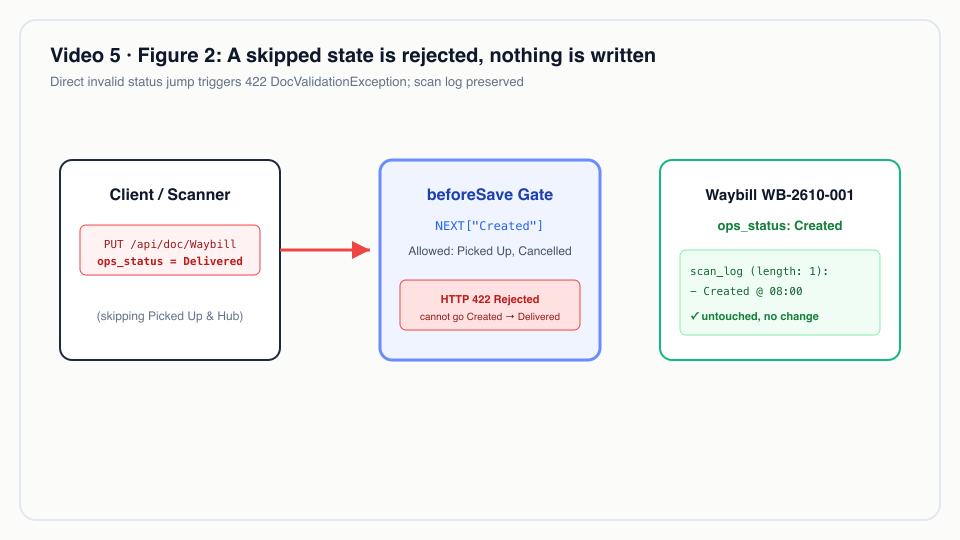 A skipped state transition is rejected by beforeSave; the document and scan log remain untouched.
How it works
The waybill is an ordinary DocType
astra-apps/express/src/main/resources/META-INF/astra/doctypes/waybill.doctype.yaml
name: Waybill
module: ops
kind: transaction
naming: { series: "WB-.YYMM.-.######" }

fields:
  - { name: order,         type: Link,   options: CustomerOrder, required: true, in-list: true }
  - { name: receiver_name, type: Data,   in-list: true, pii: true }
  - { name: ops_status,    type: Select, options: [Created, Picked Up, At Hub, Out for Delivery, Delivered, Failed Delivery, Returned, Cancelled],
      default: Created, in-list: true, projected: true, label: Ops status }
  - { name: current_hub,   type: Data,   in-list: true, projected: true }
  - { name: scan_log,      type: JSON,   read-only: true }    # appended by WaybillScanHook on every status change

permissions:
  - { role: admin, read: true, write: true }
  - { role: ops,   read: true, write: true }    # scanning is an OPS action only
  - { role: sales, read: true }
  - { role: care,  read: true }
Four declarations do most of the work:
Selectwith eight options: the kernel rejects any value outside the list before hooks run.projected: trueonops_statusandcurrent_hub:ProjectionIndexerbuildsCREATE INDEX CONCURRENTLY … ON astra_doc (tenant_id, doctype, (data->>'ops_status'))at startup, and list filters use the same expression, so the planner can pick the index.read-only: trueonscan_log: the kernel rejects any client payload containing it (DocumentValidator.rejectReadOnly), so only server-side hooks can write the history.permissions: onlyopsandadmincan scan;careandsalescan read.
Waybill is not submittable. A parcel's status is supposed to change; what must not change is its
history, and that is handled by the read-only log rather than by document immutability.
The transition table
astra-apps/express/src/main/java/io/astra/apps/express/WaybillScanHook.java
static final Map<String, Set<String>> NEXT = Map.of(
        "Created", Set.of("Picked Up", "Cancelled"),
        "Picked Up", Set.of("At Hub", "Cancelled"),
        "At Hub", Set.of("At Hub", "Out for Delivery", "Returned"),
        "Out for Delivery", Set.of("Delivered", "Failed Delivery"),
        "Failed Delivery", Set.of("Out for Delivery", "Returned"),
        "Delivered", Set.of(),
        "Returned", Set.of(),
        "Cancelled", Set.of());
View source
stateDiagram-v2
[*] --> Created
Created --> PickedUp: Picked Up
Created --> Cancelled
PickedUp --> AtHub: At Hub (hub required)
PickedUp --> Cancelled
AtHub --> AtHub: hub transfer
AtHub --> OutForDelivery: Out for Delivery
AtHub --> Returned
OutForDelivery --> Delivered
OutForDelivery --> FailedDelivery: Failed Delivery
FailedDelivery --> OutForDelivery: retry
FailedDelivery --> Returned
Delivered --> [*]
Returned --> [*]
Cancelled --> [*]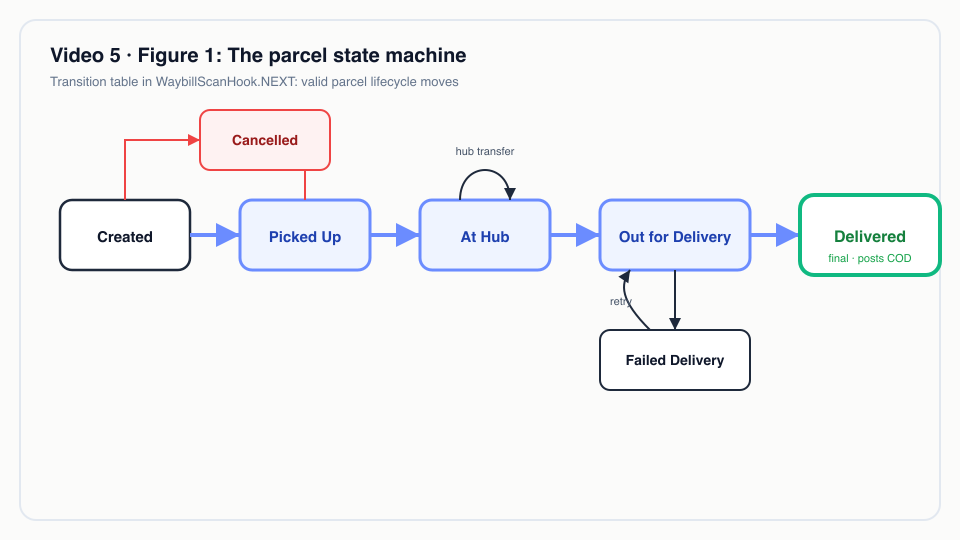 The parcel state machine declared in WaybillScanHook.NEXT. The main happy path goes from Created to Delivered.
At Hub → At Hub is allowed on purpose: a parcel moving from HCM-Tân Bình to DN-Hải Châu stays "At Hub" but
changes hub, and that transfer is a milestone worth recording. Failed Delivery → Out for Delivery models a
second delivery attempt.
The check and the log in one method
astra-apps/express/src/main/java/io/astra/apps/express/WaybillScanHook.java
@Override
@SuppressWarnings("unchecked")
public void beforeSave(Document doc) {
    List<Map<String, Object>> log = doc.get("scan_log") instanceof List<?> l
            ? new ArrayList<>((List<Map<String, Object>>) l) : new ArrayList<>();
    Map<String, Object> last = log.isEmpty() ? null : log.getLast();
    String status = doc.getString("ops_status");
    String hub = doc.getString("current_hub");

    if (last != null) {
        String from = (String) last.get("status");
        boolean same = from.equals(status) && Objects.equals(last.get("hub"), hub);
        if (same) return;
        if (!NEXT.getOrDefault(from, Set.of()).contains(status)) {
            throw new DocValidationException("ops_status cannot go from '" + from + "' to '" + status + "'");
        }
    } else if (!"Created".equals(status)) {
        throw new DocValidationException("a new waybill starts as 'Created'");
    }
    if ("At Hub".equals(status) && (hub == null || hub.isBlank())) {
        throw new DocValidationException("current_hub is required when ops_status is 'At Hub'");
    }

    if ("Delivered".equals(status)) postCollectedCod(doc);

    Map<String, Object> scan = new LinkedHashMap<>();
    scan.put("status", status);
    scan.put("hub", hub);
    scan.put("at", Instant.now().toString());
    log.add(scan);
    doc.set("scan_log", log);
}
Design notes:
- The "from" state is the last log entry, not the stored column. The log is the source of truth for history, so the check compares against what was actually recorded.
- Idempotent saves. If status and hub are unchanged (for example, editing another field), the hook returns without adding a milestone. Re-sending the same scan does not duplicate history.
beforeSaveruns on every insert and update.DocumentStore.updatecallshooks.beforeSave(doc)before theUPDATE, andpersistNewcalls it before theINSERT, which is why the new waybill created at submit already has itsCreatedmilestone. A thrownDocValidationExceptionbecomes HTTP 422 and the transaction rolls back, so the stored document is untouched.- Delivery has an accounting side effect. On
Delivered,postCollectedCodposts the collected COD: Debit 1388 (COD held by couriers) / Credit 3388 (owed to the shop), in the same transaction as the status change. If the posting fails, the parcel is not marked delivered.
The order-side veto
Cancelling an order (Video 4) cascades to its waybill, but only while the parcel has not entered the network.
astra-apps/express/src/main/java/io/astra/apps/express/OrderWaybillHook.java
private static final Set<String> CANCELLABLE = Set.of("Created", "Picked Up");
// …
@Override
public void onCancel(Document order) {
    String name = order.getString("waybill");
    if (name == null) return;
    Document waybill = docs.get("Waybill", name).orElseThrow(() -> new DocValidationException("waybill " + name + " not found"));
    String status = waybill.getString("ops_status");
    if (!CANCELLABLE.contains(status)) {
        throw new DocValidationException("cannot cancel " + order.name() + ": waybill " + name + " is already '" + status + "'");
    }
    docs.update("Waybill", name, Map.of("ops_status", "Cancelled"));
}
Note the composition: the cascade docs.update("Waybill", …, "Cancelled") itself goes through
WaybillScanHook.beforeSave, so it is validated against NEXT and appended to the scan log like any scan.
CANCELLABLE and the Cancelled entries in NEXT agree (Created, Picked Up), so the two hooks cannot
contradict each other in practice; if they ever did, the stricter one wins and the whole cancel rolls back.

View source
sequenceDiagram
autonumber
participant U as mai (Desk)
participant DS as DocumentStore.cancel
participant OW as OrderWaybillHook.onCancel
participant WS as WaybillScanHook.beforeSave
participant PG as PostgreSQL (one tx)
U->>DS: POST /api/doc/CustomerOrder/{name}/cancel
DS->>OW: onCancel(order)
OW->>PG: read Waybill ops_status
alt status in CANCELLABLE (Created, Picked Up)
OW->>WS: docs.update(Waybill, ops_status = Cancelled)
WS->>WS: check NEXT, append milestone
WS->>PG: UPDATE Waybill
DS->>PG: UPDATE order docstatus = 2, COMMIT
DS-->>U: 200
else At Hub, Out for Delivery, Delivered, …
OW-->>DS: DocValidationException
DS->>PG: ROLLBACK (nothing written)
DS-->>U: 422 cannot cancel …: waybill … is already 'At Hub'
end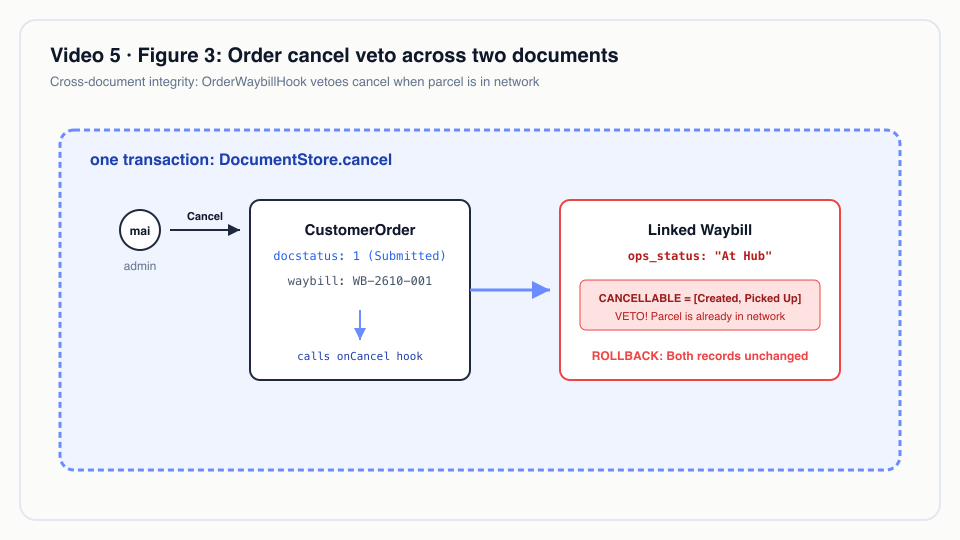 Cancelling an order is vetoed if the waybill is already in the network; both documents share one transaction and roll back together.
Why a hook and not a workflow engine
- The rule fits in nine lines of data; a BPMN engine would add a runtime, a deployment artifact and a second persistence model for the same fact.
- The check runs inside the document's own transaction, so it composes with other hooks (COD posting, order cancel) without distributed coordination.
- Every write channel (Desk, REST, other hooks through
DocumentService) reaches the samebeforeSave, so there is no client that can bypass the table.
Real-world example
A Vietnamese 3PL runs a Saigon → Đà Nẵng lane. The parcel below follows the same scans that
scripts/demo-seed.sh applies to the first seeded waybill (order for C001, COD 850,000 ₫); the clock times
and the premature Delivered tap are illustrative additions.
| Time | Scan (input) | Astra's response | Scan log length |
|---|---|---|---|
| 08:00 | Order submitted | Waybill inserted at Created |
1 |
| 09:10 | Picked Up |
200 | 2 |
| 11:30 | At Hub, hub HCM-Tân Bình |
200 | 3 |
| 18:00 | At Hub, hub DN-Hải Châu (line-haul arrived) |
200, hub transfer recorded | 4 |
| 07:30 next day | Delivered (driver taps too early) |
422 ops_status cannot go from 'At Hub' to 'Delivered' |
4 |
| 07:31 | Out for Delivery |
200 | 5 |
| 10:05 | Delivered |
200, ledger: Dr 1388 / Cr 3388 850,000 | 6 |
Meanwhile, at 14:00 on day one the shop asks sales to cancel. The order-side veto returns
cannot cancel …: waybill … is already 'At Hub', and both documents stay as they were. Customer care can now
see the full history in the scan log (and in the CDC replica, Video 6) instead of asking the hub by phone,
and finance sees exactly 850,000 ₫ held by couriers for that parcel until it is remitted.
For technical leaders
- Where the rule lives. In code (
WaybillScanHook.NEXT), reviewed and versioned like code. Changing the workflow means a deploy of the app module. That is a feature for core operational rules and a limitation if business users expect to edit transitions themselves; per-tenant variation is the job of overlays (Video 13) or Wasm scripts (Video 14), not of this table. - Write amplification.
scan_loglives inside the JSONB document, so each scan rewrites the whole document and the log grows with every milestone. For tens of scans per parcel this is fine; for very high scan rates measure row size, TOAST growth and update latency. use-case-01.md describes moving hot fields to physical columns or narrow side tables as the target design; it is not built. - Concurrency. Two scanners updating the same waybill at once: the optimistic
versioncheck makes one fail withconcurrent modification, instead of interleaving two log appends. - What to measure. Rate of 422s per transition (a spike means a scanner app or integration is out of step), share of order cancels vetoed, time spent per state (SLA), p95 scan latency.
- When not to use this pattern. Approval chains with roles, escalations and timers per step are better served by a workflow engine or Frappe-style Workflow configuration. Use the table pattern for physical or technical lifecycles with a small, stable set of states.
- Risk. Every rule in one hook means one place to get wrong; the transitions are covered by
ExpressFlowTest.submitCreatesWaybillAndCancelIsVetoedOnceInNetwork.
Try it yourself
Prerequisites: JDK 25, Docker Desktop (about 8 GB RAM), kubectl, k3d, jq, Bash 5.
make k3d-up
make demo-reset && make demo-seed
make demo-express SCENES=5 PAUSE=0
open http://localhost:8080/desk/     # sign in as quang (ops), Waybill list, filter Ops status = At Hub
Expected output, abridged from a recorded run (docs/video/v05-ops/assets/scene-05.log):
▸ Scan: picked up, then at hub
HTTP 200   { "ops_status": "Picked Up" }
HTTP 200   [ {"status":"Created",…}, {"status":"Picked Up",…}, {"hub":"DN-Hải Châu","status":"At Hub",…} ]
▸ Skipping a step is refused by WaybillScanHook
HTTP 422   { "errors": ["ops_status cannot go from 'At Hub' to 'Delivered'"], "error": "validation" }
▸ Once the parcel is in the network, cancelling the order is vetoed — and nothing changes (one transaction)
HTTP 422   { "errors": ["cannot cancel ORD-…: waybill WB-… is already 'At Hub'"], "error": "validation" }
HTTP 200   { "name": "ORD-…", "docstatus": 1 }
▸ Filter on a projected field: every parcel currently At Hub
HTTP 200   [ {"name":"WB-…","hub":"DN-Hải Châu"}, {"name":"WB-…","hub":"HCM-Tân Bình"} ]
Demo users share the password Astra@123. Sign in as mai to try cancelling the seeded order whose waybill
is Delivered.
To be accurate
- Thin slice. One hook covers the parcel lifecycle. Barcode scanners, a mobile courier app, a separate
ScanEventLedger, per-module schemas (schema_ops) and hot-field columns from use-case-01.md are target architecture and are not built. - Scans are document updates. A scan is
PUT /api/doc/Waybill/{name}withops_statusand, forAt Hub,current_hub. There is no dedicated scan endpoint. - The table is not tenant-configurable. Both tenants share the same
NEXTmap. - Returned and Failed Delivery exist in the table but are not exercised in the video.
- COD posting on Delivered is shown in Video 12; this video only shows the status side.
- The replica milestone count in the Hub scene comes from the Rust CDC worker (
scanscolumn computed as the length ofscan_log, seeastra-cdc-rust/cdc-routes.yaml); how it stays current is Video 16.
Figures
- Figure 1 · The parcel state machine
- Figure 2 · A skipped state is rejected, nothing is written
- Figure 3 · Order cancel veto across two documents
Related
- Previous: Video 4 · Document lifecycle. Next: Video 6 · Customer care sees operations.
- Deeper: Video 2 · DocType and projected fields, Video 12 · Append-only ledger (COD posting), Video 16 · Rust CDC (the replica), Video 11 · Keycloak (who may scan).
- Code excerpts: demo-code-snippets.md, S3.
- Source:
astra-apps/express/src/main/java/io/astra/apps/express/WaybillScanHook.java,astra-apps/express/src/main/java/io/astra/apps/express/OrderWaybillHook.java,astra-apps/express/src/main/resources/META-INF/astra/doctypes/waybill.doctype.yaml,astra-doctype/src/main/java/io/astra/doctype/store/ProjectionIndexer.java,astra-doctype/src/main/java/io/astra/doctype/store/DocumentStore.java,scripts/demo-express.sh(scene5).